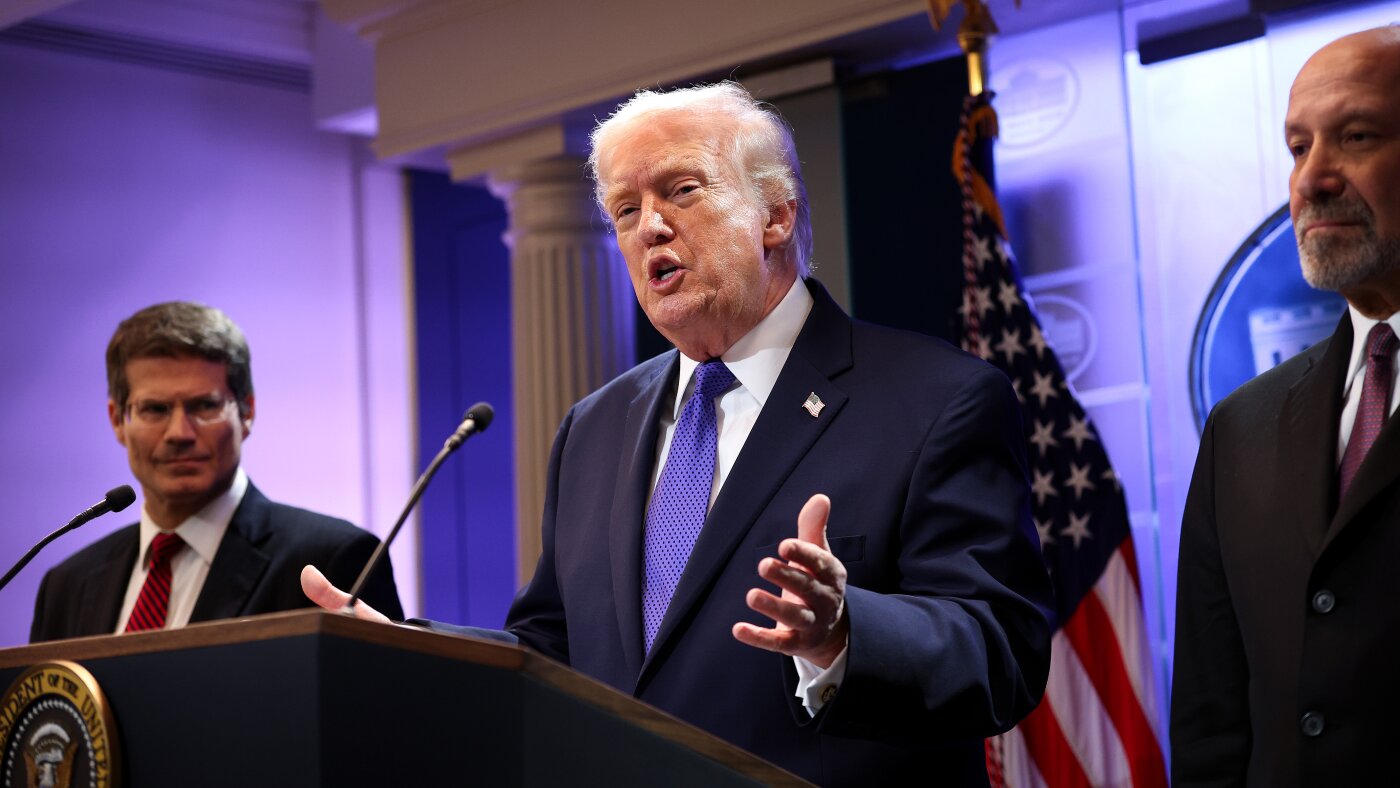

President Trump excoriated the Supreme Court majority that struck down his use of emergency powers to implement international trade tariffs. Kevin Dietsch/Getty Images
President Trump found himself at odds with the Supreme Court on Friday, marking a stark contrast to the camaraderie he displayed with Chief Justice John Roberts a year ago. Trump’s criticism came after the Supreme Court invalidated his tariffs in a decision that underscored the constitutional limits of presidential power.
During an impromptu press briefing, Trump directed his frustration at Chief Justice Roberts and conservative Justices Neil Gorsuch and Amy Coney Barrett, both of whom he appointed. “They’re just being fools and lapdogs for the RINOs and the radical left Democrats,” he stated, using the term “Republicans in name only.”
The Legal Clash Over Tariffs
The tariff dispute began with an executive order from Trump at the start of his second term, permitting him to impose tariffs on numerous U.S. trading partners. The Supreme Court’s decision, delivered by a 6-to-3 majority, emphasized that the Constitution reserves the authority to impose taxes, including tariffs, for Congress.
Chief Justice Roberts wrote, “Having just fought a revolution motivated in large part by taxes imposed on them,” the Framers of the Constitution assigned tax-imposing powers to Congress, ensuring legislative accountability to the public.
Despite the ruling, Trump intends to proceed with the tariffs, citing alternative statutes that might allow executive action without Congressional approval. However, these statutes come with significant limitations, such as time constraints and the need for Congressional consent.
Economic Implications and the Search for Alternatives
The loss of billions in tariff revenue presents a fiscal challenge, particularly as these funds were meant to counterbalance tax cuts passed by a Republican-led Congress. The U.S. government has been collecting approximately $30 billion monthly in tariffs, half of which will be nullified by the court’s decision.
The stock market remained stable despite the ruling, as investors foresee the administration attempting to replace the lost tariffs with other taxes. Yet, the legal avenues available to the president for imposing new tariffs are fraught with constraints.
Interestingly, recent economic data revealed that the U.S. economy managed to grow by 2.2% in 2025, despite the tariff complications. This growth rate, while slower than the previous year, suggests resilience in the face of trade challenges.
The Unresolved Issue of Refunds
The Supreme Court did not address potential refunds for businesses that have already paid the tariffs. This matter will be deliberated in lower courts, with the National Retail Federation advocating for a seamless refund process.
Justice Brett Kavanaugh expressed concerns over the complexity of issuing refunds, but trade lawyer Robert Leo maintains that the process is feasible, given the electronic records available.
Supreme Court Dynamics and Decision-Making
The Supreme Court’s decision reveals its cautious approach to financial matters, with Chief Justice Roberts crafting a concise ruling that maintains constitutional boundaries for the presidency.
Roberts’ opinion was supported by conservative Justices Gorsuch and Barrett, as well as the court’s three liberal justices. The decision highlights the court’s internal divisions, as evidenced by multiple concurring and dissenting opinions accompanying the ruling.
This article was originally written by www.npr.org