Good morning. You’re reading the Up First newsletter. Subscribe here to get it delivered to your inbox, and listen to the Up First podcast for all the news you need to start your day.
Highlights from Trump’s State of the Union Address
NPR’s senior political editor/correspondent Domenico Montanaro joins the newsletter today to break down the State of the Union address.
President Trump is grappling with challenging poll results, largely due to economic concerns such as rising prices and the cost of living. Yet, in his recent State of the Union address, he chose not to address these economic issues.

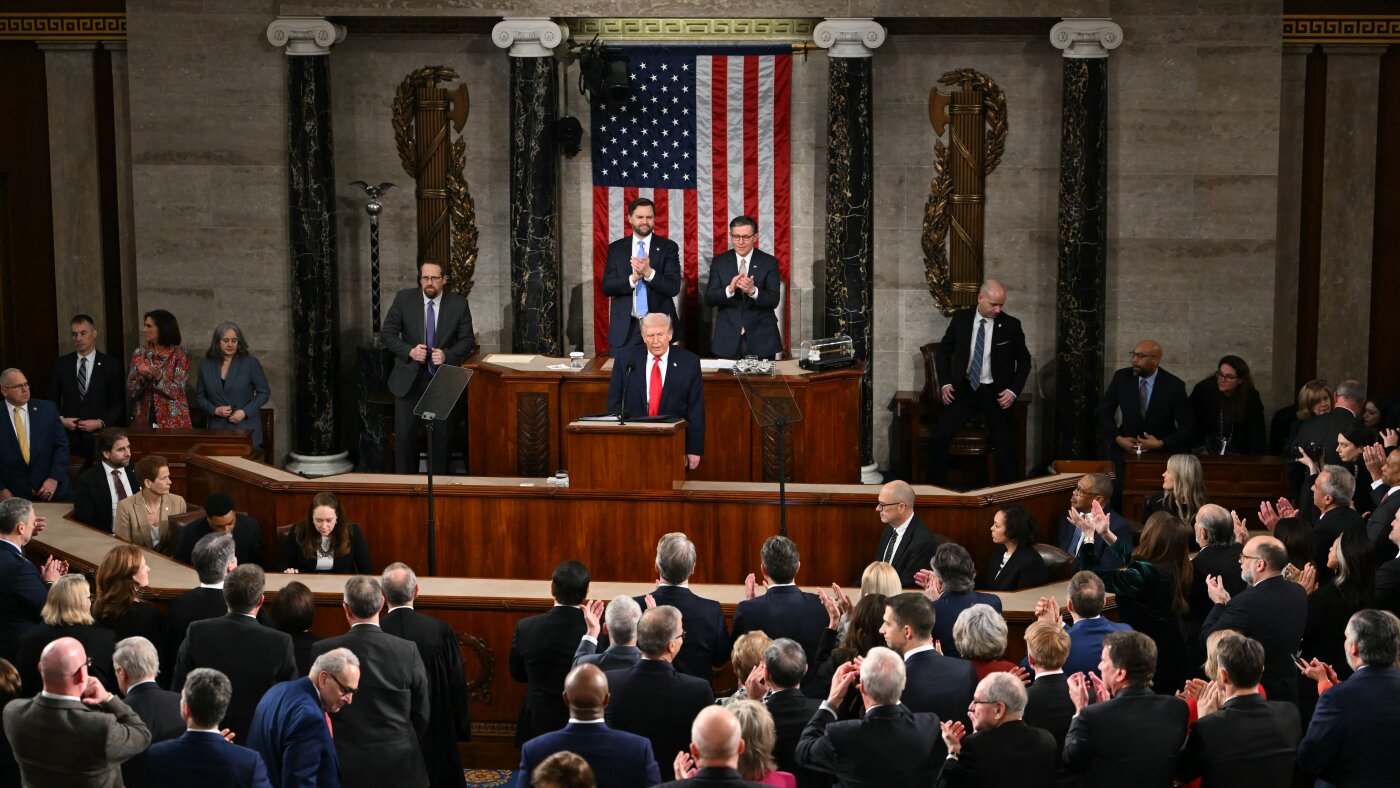
President Donald Trump delivers his State of the Union address during a Joint Session of Congress at the U.S. Capitol on February 24.
Chip Somodevilla/Getty Images
hide caption
toggle caption
Chip Somodevilla/Getty Images
In his address, Trump declared that “our nation is back” and hailed a significant “turnaround for the ages.” The speech, notably long, focused on familiar themes such as immigration and cultural issues.
Here are five key points from the address:
- Economic challenges were left unaddressed. Despite economic difficulties being a top concern for voters, Trump avoided this topic and reiterated his stance on tariffs, even critiquing the Supreme Court justices nearby for deeming many tariffs illegal.
- The midterm agenda remains unchanged. Trump’s focus remains on crime committed by immigrants and cultural debates. While effective in 2024, these topics now include his track record on the economy and immigration.
- Absence of a legislative plan. Trump’s speech lacked a detailed legislative agenda, consistent with his recent efforts to consolidate power.
- Diverse Democratic reactions. Responses varied from silent protests to Virginia Gov. Abigail Spanberger’s official economy-focused response, highlighting potential directions for the party.
- Trump’s political standing remains steady. Perceptions of Trump are unlikely to shift significantly, as demonstrated by past trends. His speech was more of a spectacle, featuring medals and honors, and this showmanship is expected to continue.
House Blocks Aviation Safety Bill
The House of Representatives narrowly voted down a bipartisan aviation safety proposal known as the ROTOR Act. Crafted after a tragic helicopter and jet collision near Washington, D.C., it was supported by investigators and victims’ families but lost Pentagon backing before the vote. Read more about the bill’s rejection.
- 🎧 The ROTOR Act aimed to expand ADS-B technology usage, which enhances aircraft location awareness. The National Transportation Safety Board believes it could have prevented the collision. Despite initial support, the Pentagon raised concerns over “budgetary burdens and security risks.” The bill’s sponsors intend to seek another House vote.
Pentagon and Anthropic at Odds Over AI Safety
Defense Secretary Pete Hegseth threatens to penalize AI firm Anthropic due to their refusal to relax safety standards for military use. During talks with CEO Dario Amodei, Hegseth indicated potential consequences, such as ending a $200 million contract and possibly appropriating Anthropic’s AI technology. More details on this standoff can be found here.
Deep Dive into U.S. Immigration Court Changes

The front lobby of the Miami Immigration Court seen on Jan. 28, 2026 in Miami, Florida.
Joe Raedle/Getty Images
hide caption
toggle caption
Joe Raedle/Getty Images
The Trump administration’s decision to dismiss nearly 100 immigration judges in 2025 has significantly reshaped the landscape of the U.S. immigration courts. These dismissals, coupled with resignations, have reduced the number of judges by about 25% over the past year, even with new appointments. The Justice Department Executive Office for Immigration Review (EOIR) lost over 400 staff members, including legal assistants and advisers. The administration maintains that these actions were necessary to address “lenient” asylum decisions, yet staff morale has plummeted, and case backlogs have worsened.
- ➡️ Remaining staff report a starkly different judicial environment, citing increased pressure to align with administrative priorities and witnessing ICE arrests occurring in court hallways.
- ➡️ Although new judges have been appointed, their distribution has not compensated for the loss in many courts, with some courts receiving as few as one new judge.
- ➡️ Smaller courts have been hit hardest, with 14 now operating with two or fewer permanent judges.
Spotlight on Vadim Neselovskyi’s Musical Journey

Pianist-composer Vadim Neselovskyi drew on the pain and suffering caused by the war in Ukraine, but also hope for the future, for his piano and strings suite, Perseverantia.
Arkady Mitnik
hide caption
toggle caption
Arkady Mitnik
Born in Odesa, Ukrainian pianist and composer Vadim Neselovskyi has been deeply affected by the ongoing conflict in Ukraine, particularly the repeated bombings of his hometown. His latest album, Perseverantia, reflects this turmoil. The 11-part suite for piano and strings merges classical and jazz elements to convey the sounds of war, empathy, and hope. In his Morning Edition interview, Neselovskyi recounted how he couldn’t play music for three weeks after the invasion. When he finally returned to the piano, he played intense, violent chords that became the second movement, “Tanks Near Kyiv.” Discover more about his creative process by listening to snippets of his album and reading about his inspirations here.
3 Things to Know Before You Go

Horses, like the Norwegian Fjord variety apparently yawning in this image, generate both a high frequency and a low frequency when they whinny.
ullstein bild/Getty Images
hide caption
toggle caption
ullstein bild/Getty Images
- A recent study reveals that horses produce high and low frequencies when they whinny, potentially allowing them to communicate complex information.
- Flavor Flav extended an invitation to the U.S. women’s Olympic hockey team for a “real celebration” in Las Vegas after Trump’s oversight of the team during a congratulatory call with the men’s team. Read more here.
- The Fear of Flying Clinic offers a four-day course to help those with flight anxiety. This program combines gradual exposure with professional support. Approximately 25 million Americans are affected by this phobia. Learn more about the clinic’s approach here.
This newsletter was edited by Suzanne Nuyen.
This article was originally written by www.npr.org