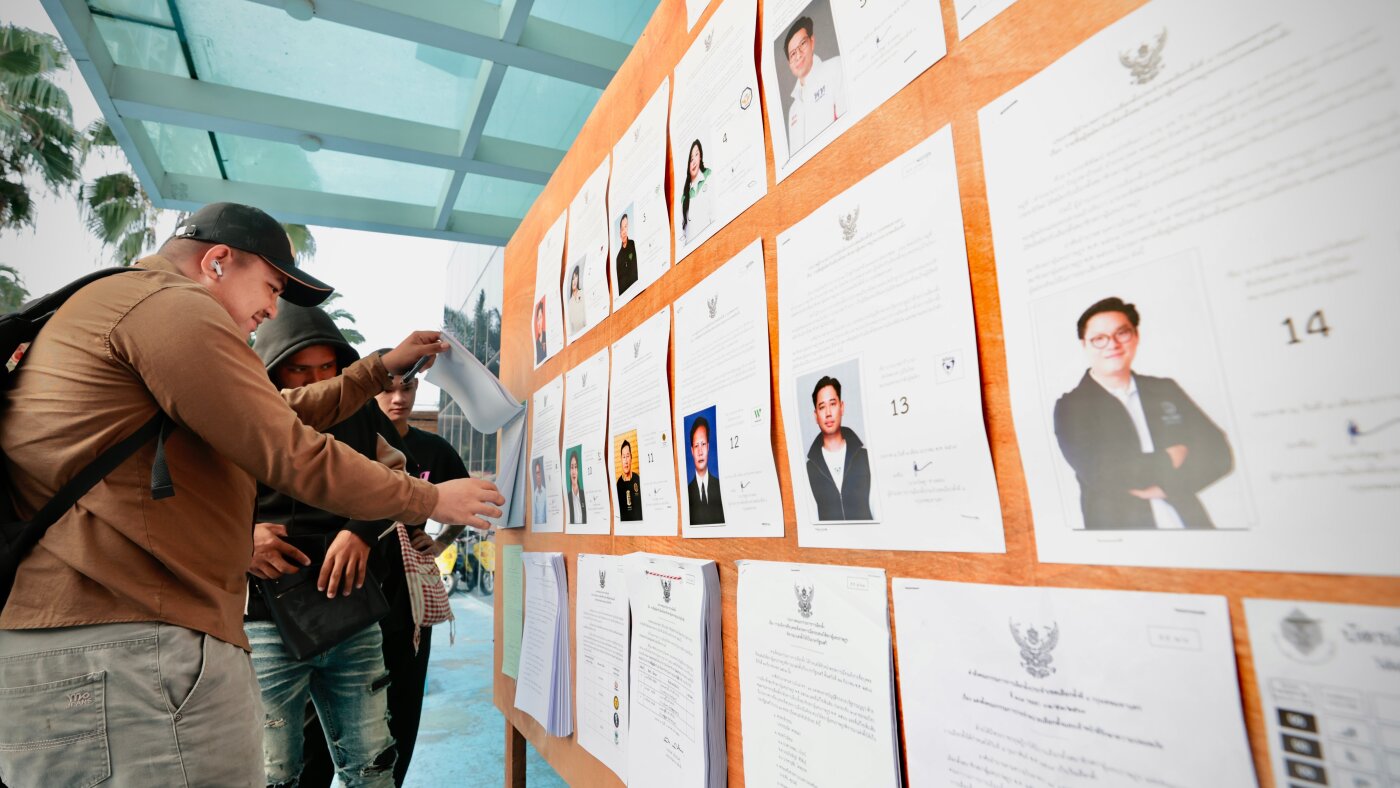

Voters look at candidates listed on a display board before entering a voting station for the general election in Bangkok, on Sunday, Feb. 8, 2026.
Wason Wanichakorn/AP
In Thailand’s political landscape, a fierce competition is underway as voters head to the polls. This Sunday’s general election represents a critical moment, with 53 million registered voters deciding among three primary political ideologies: progressive, populist, and traditional patronage politics.
The election, amidst a backdrop of sluggish economic growth and rising nationalism, features over 50 parties. Yet, only three major contenders—People’s Party, Bhumjaithai, and Pheu Thai—appear capable of securing a mandate nationwide.
The path to the prime minister’s office requires a simple majority from the 500 elected lawmakers.
No outright winner expected
Forecasts indicate that forming a coalition government will be inevitable, as no single party is expected to achieve a majority. The People’s Party, led by Natthaphong Ruengpanyawut, is anticipated to win the most seats but faces challenges due to its reformist agenda, which is not shared by its main competitors.
This party, succeeding the dissolved Move Forward Party, which was blocked from forming a government in 2023, continues to push for reforms in the military, police, and judiciary, appealing particularly to younger and urban voters.
“I think we will get the mandate from the people, and we promised the people that we will form the people’s government to bring policies that benefit all, not a few in the country,” Natthaphong stated after voting in Bangkok.
Reformist party softens its pitch
The People’s Party has had to adjust its approach, downplaying its stance on laws concerning criticism of the monarchy due to legal restrictions, while emphasizing economic policies. The party’s softened stance may weaken its core support, as last election’s momentum as an alternative to military-led governance cannot be leveraged this time.
Napon Jatusripitak from the Center for Politics and Geopolitics at Thailand Future notes that the party’s critique of the military could be a disadvantage given the surge in patriotism following recent border tensions with Cambodia.
The Bhumjaithai Party, led by Prime Minister Anutin Charnvirakul, is regarded as the primary choice of the royalist-military establishment. Anutin, who assumed office last September, emphasizes national security and economic growth, particularly after recasting himself as a wartime leader following clashes with Cambodia.
“We have done everything that we had to, but we cannot force the mind of the people. We can only present ourselves, and hope that the people will have faith in us,” Anutin stated after voting in Buriram province.
With effective grassroots organizing, Bhumjaithai is seen as a strong contender to lead the next government, utilizing traditional patronage politics.
Thaksin’s political machine
The Pheu Thai Party, affiliated with former Prime Minister Thaksin Shinawatra, continues to make political comebacks despite past oustings by conservative courts. The party now focuses on economic revival and populist promises, with Thaksin’s nephew, Yodchanan Wongsawat, positioned as the prime ministerial candidate.
“I’m excited, because I think today will be another busy day for the country’s democracy,” Yodchanan conveyed to reporters post-voting.
Additionally, voters are participating in a referendum on whether to replace Thailand’s 2017 military-drafted constitution. This vote seeks to authorize parliament to initiate drafting a new constitution, a move supported by pro-democracy groups but cautioned against by conservatives who warn of potential instability.