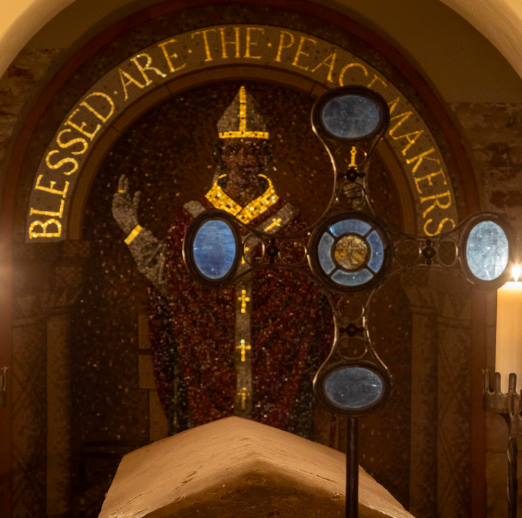
York Minster has become the focal point of a historic reunion, as fragments of a medieval shrine dedicated to St William of York are showcased for the first time in nearly five centuries. This event marks a significant chapter in the cathedral’s history, aligned with its 2026 program.
The stone remnants, originally part of a grand two-storey shrine constructed over William’s tomb, are now the centerpiece of a brand-new exhibition. This display, complemented by an immersive film, delves into the life, legacy, and untimely death of York’s patron saint.
The staging of this exhibition is particularly timely, coinciding with the 800th anniversary of St William’s canonisation.
St William’s story is one of devotion and loyalty to York, interwoven with intense political and ecclesiastical strife. In the 12th century, he was appointed Archbishop of York twice, amid fierce opposition from church factions.
His unexpected illness during a Mass led to speculation about poisoning, a mystery that remains unsolved to this day.
Following his death, William’s tomb became a magnet for pilgrims, seeking healing and witnessing miracles attributed to him.
Pope Honorius III recognized this widespread veneration in 1226, officially declaring William a saint.
Over the centuries, numerous shrines were erected in his honor, establishing his resting place as a premier pilgrimage destination in medieval England.
However, the English Reformation brought this history to an abrupt end. Between 1538 and 1541, the shrine was dismantled and hidden beneath the streets of York.
Archaeologists later discovered the care with which the stones were buried, hinting at hopes of their eventual recovery.
The fragments currently on exhibit were uncovered during archaeological digs and preserved by the Yorkshire Museum.
These pieces have been loaned to York Minster by the York Museums Trust, offering visitors a rare glimpse of the shrine’s original grandeur.
The exhibition also displays artifacts connected to William’s story, such as a Sicilian ivory casket influenced by Arabian design, a replica of William’s only surviving archiepiscopal seal, and a stone linked to one of his famous miracle accounts.
Accompanying the shrine fragments is a digital reconstruction, created using intricate 3D scans of the surviving pieces.
This reconstruction is featured in a new film, presented in a custom-built cinema beneath the cathedral, showcasing what the shrine might have looked like before its destruction.
The digital project was developed with expertise from the cathedral’s Centre of Excellence for Heritage Craft Skills and Estate Management, alongside York-based visual effects company Viridian FX, known for work on major television series like House of the Dragon. The film was produced by local studio Hewitt & Walker.
Dr. Jennie England, Research Coordinator at York Minster and curator of the exhibition, emphasized the importance of the anniversary year in reflecting on William’s impact on the city.
“The return of these fragments of St William’s shrine to York Minster after nearly 500 years is hugely significant,” she said.
“Although our methods would be unimaginable to the craftspeople who created this medieval masterpiece, our commitment to ensuring that as many people as possible can connect with this holy and historic individual is much the same as theirs.”
The exhibition and film experience began on January 31 and will be available throughout 2026 during regular sightseeing hours. Entry is included with a York Minster sightseeing ticket.
This article was originally written by www.christiantoday.com