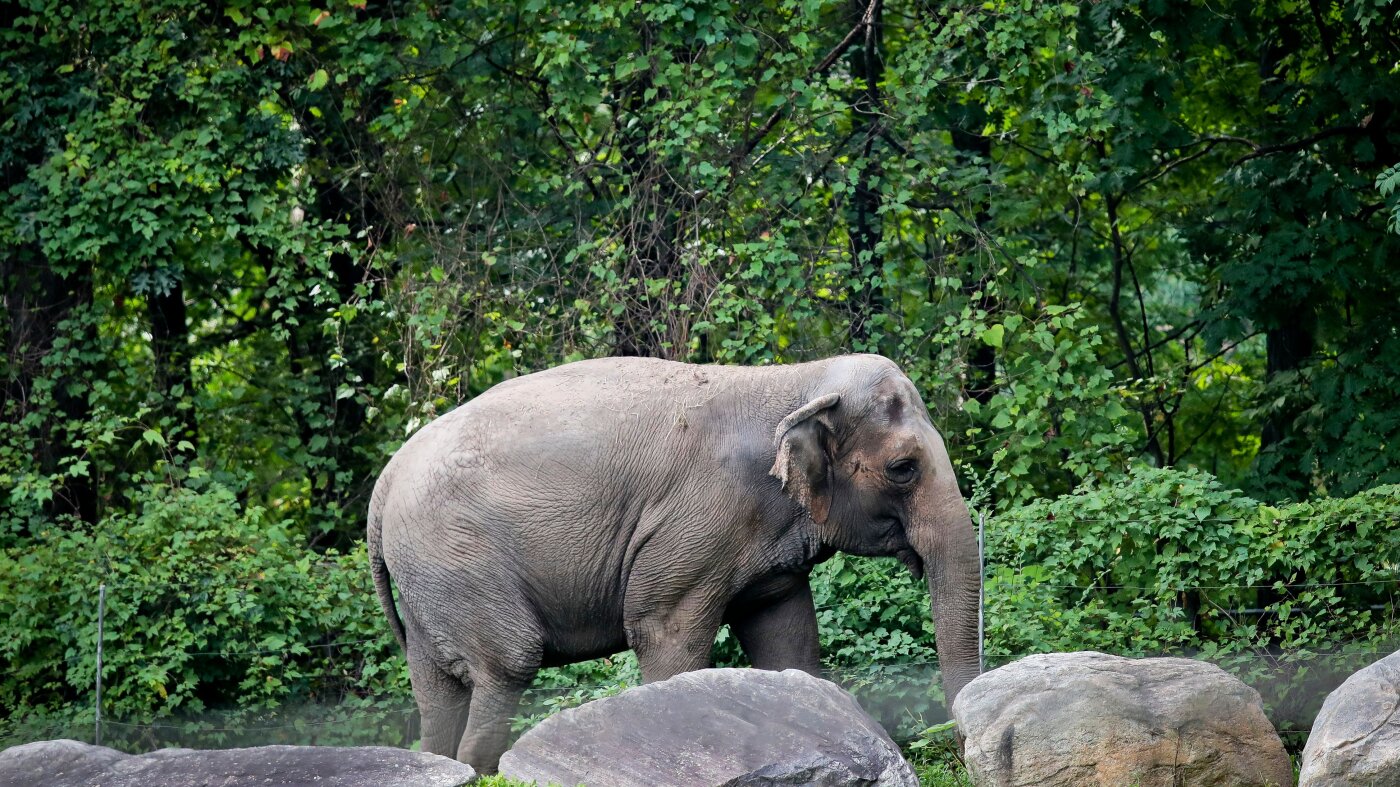

Bronx Zoo elephant “Happy” strolls inside the zoo’s Asia Habitat in New York, Oct. 2, 2018.
Bebeto Matthews/AP
Bebeto Matthews/AP
Happy, the beloved Asian elephant at the Bronx Zoo, has been euthanized at the age of 55, marking the end of an era for a creature that not only fascinated researchers with her intelligence but also became central to a significant animal rights debate.
The Bronx Zoo, where Happy spent nearly 50 years, announced that the decision to put her down was due to worsening age-related health issues. Recent examinations revealed that Happy’s kidney and liver functions were declining, and a necropsy later uncovered arthritis and large uterine tumors. These tumors were undetectable through conventional exams.
“She was a wonderful elephant,” said interim zoo director Craig Piper, reflecting on the deep bond shared by the zookeepers and Happy over the decades. “She served as a tremendous ambassador for elephants and for elephant conservation.”
With Happy’s passing, the Bronx Zoo now houses just one elephant, a 57-year-old named Patty. The Wildlife Conservation Society, which oversees the zoo, decided two decades ago not to acquire more elephants.
Happy’s journey began in the wilds of Asia. She was transported to the United States as a one-year-old and was named after a character from “Snow White and the Seven Dwarfs.” Her arrival at the Bronx Zoo in 1977 marked the start of a long and impactful life.
Happy was known for her playful interaction with zookeepers, often motivated by her favorite treats like watermelon and strawberries. She even had a clever habit of tucking treats into her ear for later enjoyment, according to Keith Lovett, the zoo’s director of animal programs.
In 2005, Happy demonstrated that elephants possess self-awareness by recognizing herself in a mirror—a trait shared by only a few species. This finding was groundbreaking in understanding elephant cognition.
After the death of her last elephant companion in 2006, Happy lived separate from the zoo’s other elephants, although they could still see and interact with each other through barriers. This arrangement was made for their safety.
Despite the controversy surrounding urban zoo exhibits and their adequacy for such large, intelligent animals, institutions like the Bronx Zoo argue that they play a crucial role in wildlife conservation by engaging the public.
The Nonhuman Rights Project, an activist organization, initiated a lawsuit in 2018 to have Happy recognized legally as a “person” and moved to a sanctuary. This marked the first case of its kind for an elephant. The group argued that Happy was “an extraordinarily cognitively complex and autonomous nonhuman being” who deserved freedom from her enclosure.
The zoo countered by emphasizing the care and enrichment Happy received and argued that moving her could be detrimental. The New York state court sided with the zoo, rejecting the activists’ claims, although two judges voiced strong dissents, calling her captivity “inherently unjust and inhumane.”
In her final days, Happy chose to remain in an off-exhibit area, receiving palliative care from the zoo staff. Meanwhile, Patty continues to thrive at the Bronx Zoo, and careful consideration is being given to her future.
The Wildlife Conservation Society had indicated that once only one elephant remained, considerations would be made about relocating the animal to another zoo if suitable conditions were met. Piper mentioned that any decision regarding Patty would be made thoughtfully.
This article was originally written by www.npr.org