The Letter to the Hebrews describes a “cloud of witnesses,” a metaphorical gathering of believers throughout history. This concept has expanded over the centuries, incorporating numerous figures and events that have shaped the Christian Church. This column delves into historical figures and events that have contributed to this “cloud,” highlighting their impact on the Church today.
Throughout Christian history, believers have often drawn parallels between their contemporary world and biblical narratives. This practice has sometimes led to imaginative interpretations, particularly with Old Testament events. One extraordinary example of this approach is the creation of the legendary figure of King Arthur.
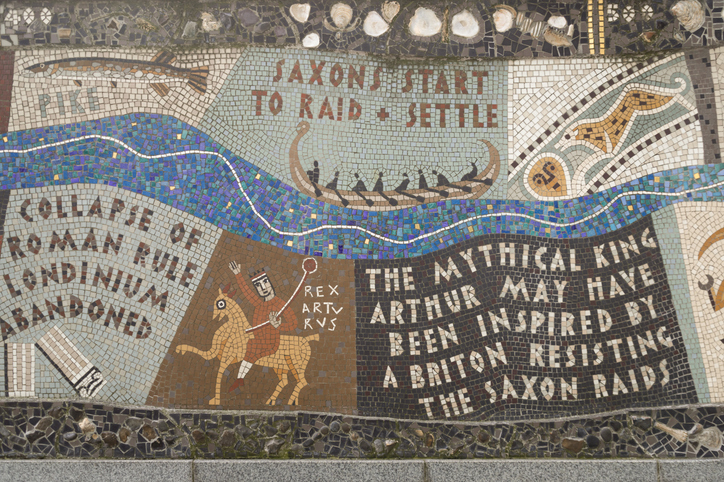
After the collapse of Roman rule in Britain during the early 5th century, native British writers attempted to explain the ensuing societal chaos. They grappled with questions about the fragmentation of Roman Britain and the rise of pagan Anglo-Saxon dominance in previously Christian regions. Early medieval authors frequently turned to theology, rather than military or social analysis, to answer these questions, interpreting events through a biblical lens.
Biblical Models as Interpretative Tools in Early Medieval Britain
The interpretation of events in Early Medieval Britain underwent three significant stages. Initially, in the 6th century, the British writer Gildas proposed that the Anglo-Saxons were divinely sent to punish the Britons for their sins, akin to the biblical exile and conquest of Israel.
By the 8th century, the Anglo-Saxon historian Bede expanded on this idea, framing it as a divine justification for English conquest. The fact that this argument originated from a British writer allowed Bede to utilize it effectively to support English dominion.
Later, British writers from the early Welsh societies countered this English perspective. In the 9th-century Historia Brittonum and the 10th-century Annales Cambriae, they reimagined the legendary hero Arthur as a divinely favored war leader, similar to Joshua, resisting the invading Anglo-Saxons. This narrative supported the notion that the Britons, now the Welsh, remained under divine protection, encouraging resistance against English power.
Gildas: British Sin and Divine Judgement
Gildas, writing in the 6th century, produced a significant work titled De Excidio et Conquestu Britanniae (On the Ruin and Conquest of Britain). His work was less a historical account and more a moral sermon modeled on Old Testament themes, explaining the disasters that befell Christian Britain after Rome’s departure. Gildas argued that the Britons, like the Israelites, had sinned and faced divine punishment.
He described Britain as a land of prosperity marred by moral corruption and political disunity. According to Gildas, British leaders were tyrannical, the clergy negligent, and society consumed by greed and violence. He lamented, “Britain has kings, but they are tyrants; she has judges, but unrighteous ones.” The parallels to Old Testament prophetic denunciations were deliberate.
Gildas recounted how the Britons invited English mercenaries, referred to as “Saxons,” to defend against northern enemies, only for these mercenaries to rebel and ravage the land. This catastrophe was depicted as divine judgement: “the fire of vengeance, justly kindled by former crimes, spread from sea to sea.” He explicitly drew comparisons to the Assyrian assault on Judea.
Despite the grim narrative, Gildas offered hope, suggesting that divine punishment could be reversed through repentance. He recounted how the Britons, under Ambrosius Aurelianus, achieved a significant victory at the Battle of Mount Badon, demonstrating that repentance could restore divine favor.
Bede: English Domination as Divine Will
Two centuries later, the English monk Bede adapted Gildas’ framework to further the English narrative. In his 731 work Historia Ecclesiastica Gentis Anglorum (Ecclesiastical History of the English People), Bede portrayed the English conquest as part of God’s providential plan.
While Gildas lamented British failures, Bede viewed them as divine providence favoring English dominance. He depicted the English settlement as both legitimate and spiritually significant, with the English emerging as a new chosen people after converting to Christianity. Bede criticized the Britons for not evangelizing the Saxons or Angles, suggesting a divine replacement rather than punishment.
Bede’s narrative justified English dominance through religious conversion, framing the English as integrated into sacred history. His historiography offered a moral rationale for English territorial control, reflecting divine approval.
Arthur: The Welsh Reinterpretation
In response to Gildas and Bede, Welsh chroniclers in the 9th century reasserted British resistance narratives. The Historia Brittonum, associated with Nennius, countered English triumphalism by elevating the figure of Arthur, a legendary war leader.
Historians debate whether Arthur was a real resistance leader, a composite figure, or mythological. The Historia Brittonum presents Arthur as a divinely supported hero, akin to Joshua, leading the Britons against Saxon invaders. The text lists twelve battles, emphasizing divine intervention in British victories.
This reinterpretation presented the Britons as defenders of Christian Britain, challenging the narratives of Gildas and Bede. The memory of Arthur offered ideological encouragement against English aggression, asserting that God supported British resistance.
The 10th-century Annales Cambriae further reinforced Arthur’s image as a holy warrior, bearing the cross of Christ into battle. This narrative offered a theological counterpoint to English narratives, presenting the Britons as divinely favored.
Historical Narratives and Biblical Models
The differing interpretations by Gildas, Bede, and Welsh chroniclers highlight the influence of theology and politics in early medieval history writing. Each sought biblical models to frame their narratives, leading to varied interpretations of events.
Gildas viewed English invasions as divine punishment; Bede saw English dominance as providential; Welsh chroniclers reimagined Arthur as a divinely favored champion. These narratives fueled interest in Arthurian legends, ultimately contributing to the medieval Arthurian mythos.
For the public-domain online translations quoted in this piece, see:
Gildas: https://en.wikisource.org/wiki/Six_Old_English_Chronicles/The_Works_of_Gildas
Historia Brittonum (History of the Britons): https://avalon.law.yale.edu/medieval/nenius.asp
Annales Cambriae (Welsh Annals): https://d.lib.rochester.edu/camelot/text/boyer-battle-of-mt-badon-overview.html
This article was originally written by www.christiantoday.com