New Research Links Socioeconomic Factors to Brain Development in Preteens
Emerging evidence suggests that the surroundings in which children grow up have profound impacts on their brain development. A recent study published in the journal Science reveals that the socioeconomic conditions of a child’s neighborhood can leave identifiable patterns on their brains, as observed through MRI scans.
Conducted among over 2,300 children ages 9 and 10, the study highlights the significant role of environmental factors such as income, education, and neighborhood quality on brain structure. These findings challenge prior research that focused more on cognitive abilities and mental health without considering socioeconomic backgrounds.
Lead researcher Scott Marek, an assistant professor of radiology at WashU School of Medicine, emphasizes the need to understand how these socioeconomic elements become embedded in biological systems. “Something is going on in these neighborhoods,” Marek states.
Stanford University’s psychology professor Russell Poldrack, who wasn’t part of the study, points out the research’s revelation that the environment significantly impacts brain development. This insight may prompt re-evaluation of past studies linking brain differences solely to cognitive factors.
Dr. Nico Dosenbach from WashU Medicine, another study author, acknowledges that while IQ and mental health have some influence, “socioeconomics was, by a wide margin, absolutely the dominant variable.”
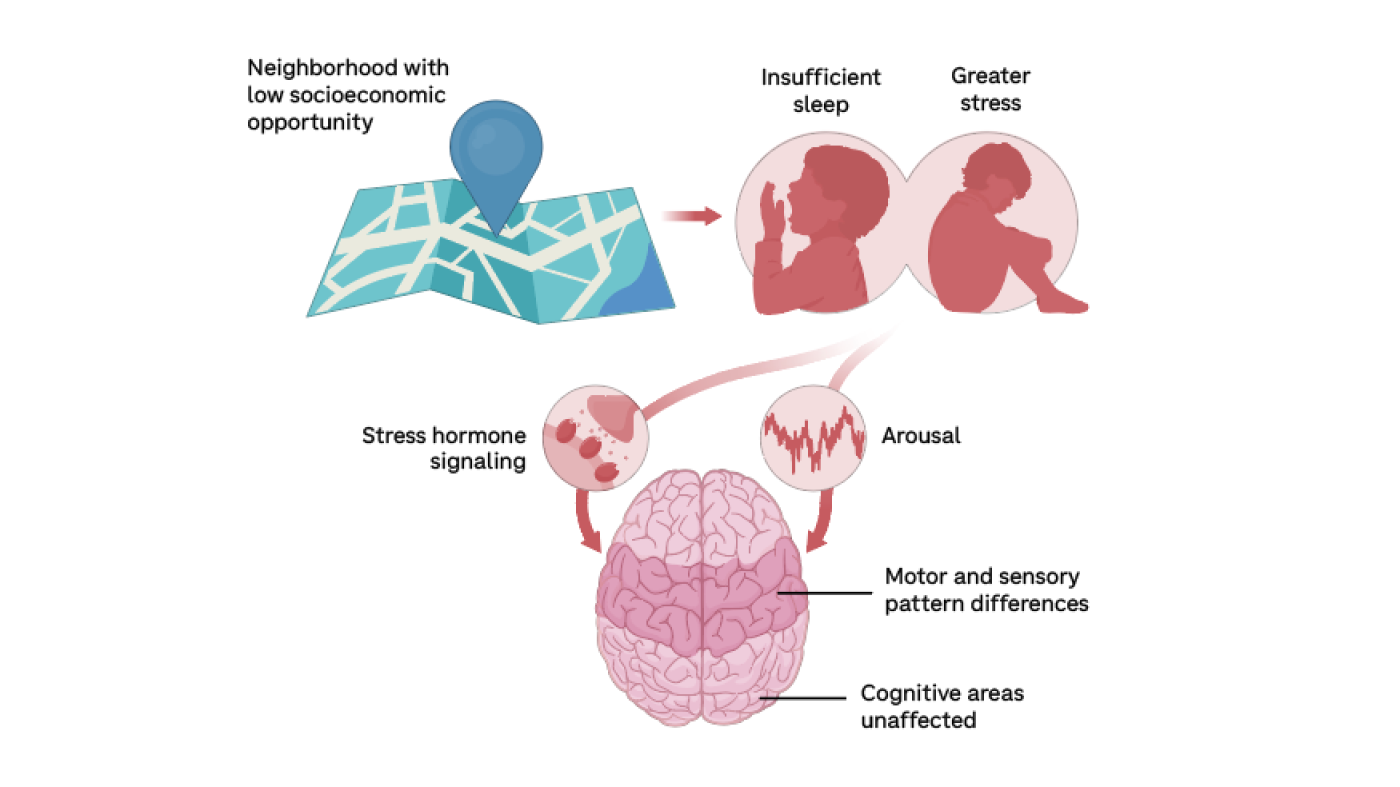
The study also finds a connection between brain differences and elements like less sleep and increased stress, prevalent in lower-income neighborhoods. These conditions are suspected contributors to alterations in brain circuits responsible for alertness and sensory processing.
Dr. Theodore D. Satterthwaite, an associate professor at the University of Pennsylvania, notes that this study adds to a growing body of research highlighting the powerful influence of childhood environments on brain development. Satterthwaite co-authored a perspective article accompanying the study.
Comprehensive Examination of Brain Influences
This research utilized data from the Adolescent Brain Cognitive Development (ABCD) Study, which tracks children from ages 9 and 10. The researchers examined brain scans to identify structural differences and related these to various environmental and cognitive factors.
Through their analysis, socioeconomic factors emerged as the primary influences, affecting brain regions linked to sensory processing and motor control. The study suggests that sleep deprivation, heightened stress, and excessive screen time, common in economically disadvantaged areas, may be contributing to these brain differences.
While the study stops short of proving causation, Marek notes, “the data are screaming that we should be looking at sleep, stress, and screens if we want to get somewhere.”