
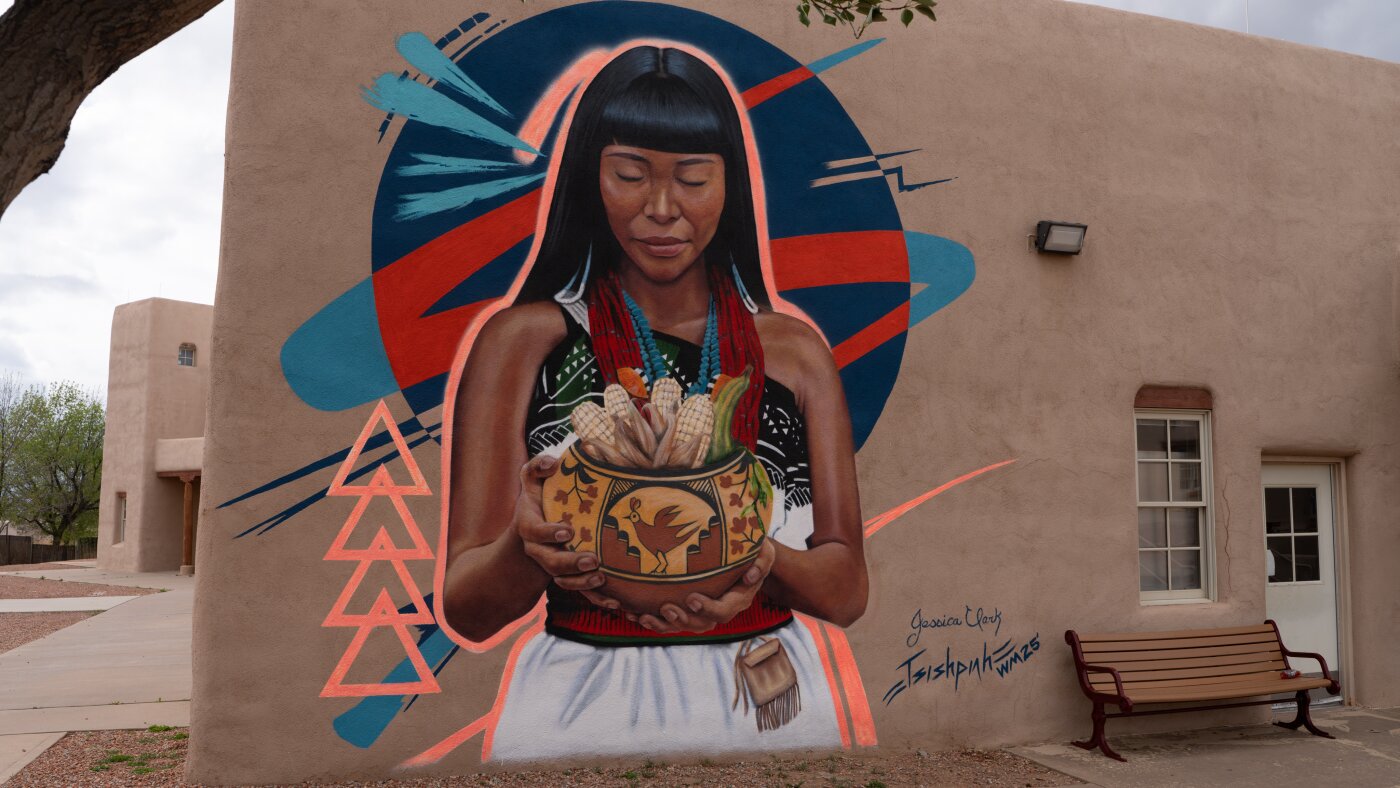
In the heart of New Mexico, the Santa Fe Indian School (SFIS) stands as a testament to resilience and cultural revival. Once a symbol of forced assimilation, the school now embraces its Native American heritage, offering a unique educational experience rooted in tradition and community.
Established in 1890, SFIS served as a federal boarding school aimed at assimilating Native American children. According to Kyle Shutiva, a junior at the school, “We were established in 1890 as a Native American boarding school. It’s still a boarding school, but not how people would expect.” The school’s history is marred by stories of cultural suppression, where students faced penalties for speaking their native languages.
Read more about the history of federal Indian boarding schools.
Today, the SFIS campus is a vibrant center of Native culture. Students walk between classes wearing traditional jewelry alongside their school attire. Inside the library, a re-categorization effort is underway to better reflect Native American contributions, moving beyond the Dewey Decimal System’s classification of Native materials as “History of North America.”
“We’re just trying to decolonize this area,” Shutiva says, highlighting the ongoing transformation. “Because [the] 970s show that Native Americans are history, but we’re still here, truly.”
A Different Path
Unlike other federal schools, SFIS was not entirely isolated. In the 1930s, New Deal-era funding brought opportunities for local Native artists, influencing the school’s evolution. “Santa Fe Indian School was lucky because there was a culture here in Northern New Mexico,” explains Christie Abeyta, the school’s superintendent, emphasizing the focus on art and craftsmanship.
Esteemed artists like Georgia O’Keeffe and Dorothy Dunn took an interest in the local art scene, with some even teaching at the school. For the past 50 years, SFIS has been under tribal control, severing its federal ties.
“When we became tribally controlled,” recalls Lisa Longeteig, the school’s librarian, “that was a key piece.” This shift allowed local tribes to set the curriculum, fostering a resurgence of language and cultural studies.
“Since then, we’ve seen a dramatic increase, even in my time here, in language offerings,” Longeteig notes. This includes the teaching of San Felipe Keresan, a dialect taught by Tasha Pino, a language teacher and former student of SFIS.
A Family History
For many students, SFIS represents a reconnection with their heritage. Kyle Shutiva, whose great grandmother Lucy Lewis was a renowned Acoma potter, transferred to SFIS to reconnect with his roots. “I felt out of touch with my native heritage,” he admits. Similarly, new student Alivia Armijo traveled from Ohio to attend SFIS, drawn by its focus on tradition and culture.
Armijo, who is learning about buffalo dances and Pueblo art, appreciates being among peers who share her background. Educators like Mark Lee Moquino are working to integrate cultural elements throughout the curriculum, using traditional practices to enhance subjects like math and art.
Moquino envisions expanding language offerings and embedding cultural teachings into the wider educational framework. “There’s ways to incorporate any aspect of our culture into the western education system,” he asserts, highlighting SFIS’s role as a beacon of cultural preservation and education.





Comments are closed.