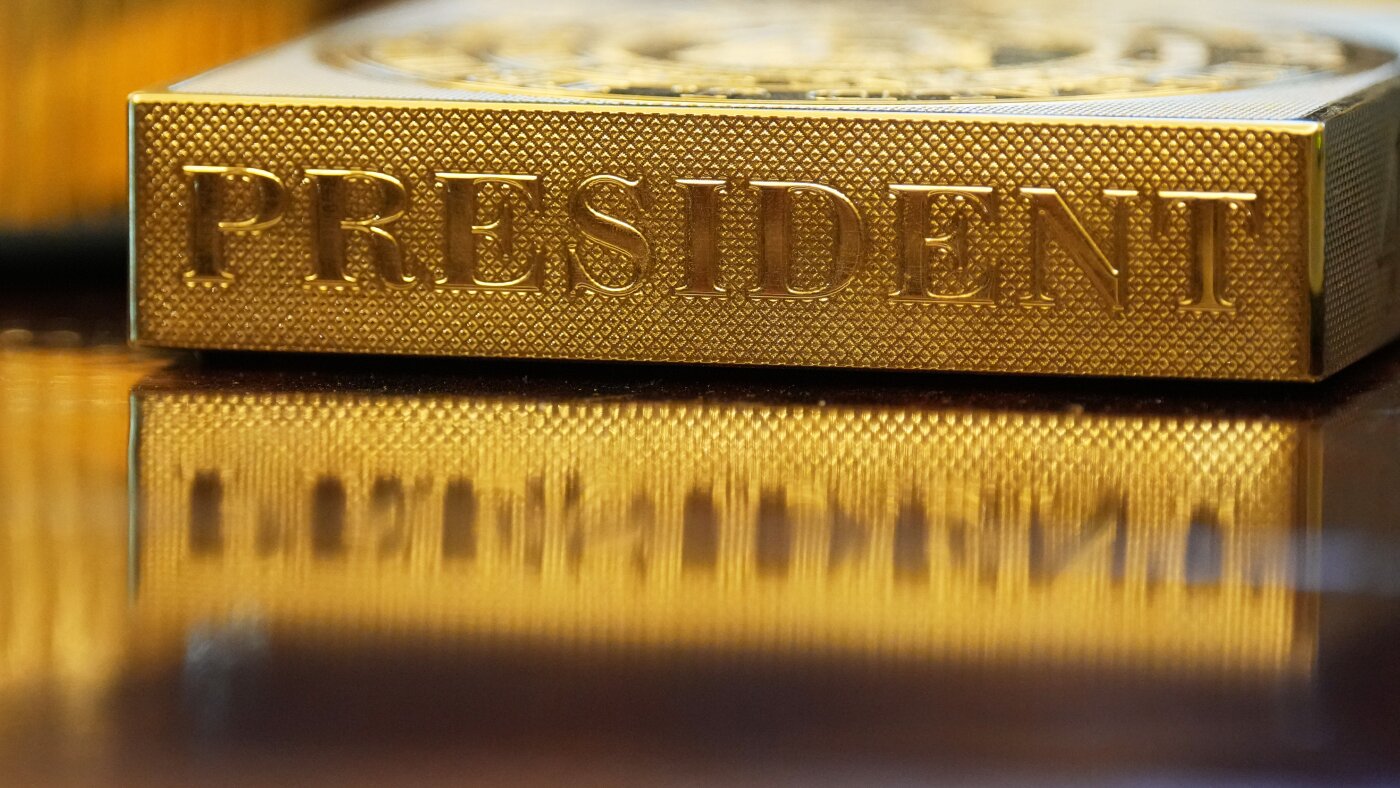

A gold-colored item embossed with the word “President” sits on the Resolute desk in the Oval Office of the White House on Nov. 10, 2025.
Jacquelyn Martin/AP
hide caption
toggle caption
Jacquelyn Martin/AP
The New York Times journalist Jonathan Swan has chronicled President Trump’s political journey for over a decade, covering his campaigns and both terms in office, including the ongoing conflict with Iran. Swan notes that aside from the COVID-19 pandemic, he hasn’t seen Trump as challenged as he is now.
“It’s pretty clear he realizes that this war [with Iran] has not gone well, has not played out the way that Netanyahu pitched him or that Trump himself thought [it] would play out,” Swan says. “Trump is someone who is naturally given to hubris, but I think we saw a very extreme version of that with this war.”
Swan and co-author Maggie Haberman engaged over 1,000 sources for their latest book, Regime Change: Inside the Imperial Presidency of Donald Trump. This work delves into the president’s unrestrained influence on American governance and foreign policy.

In an interview for the book, Trump expressed a strong desire to be remembered as a “great man of history.” He shared a document with Swan and Haberman comparing himself to historical figures notorious for their power, such as Mao, Stalin, and Genghis Khan.
“[The list had] nothing to do with morality, all just about pure power projection. And Trump was relishing being in their company,” Swan says. “Maggie and I talked about it afterwards, and it really occurred to us that when you look at it through that lens, his second term makes a lot more sense.”
This focus on power is evident in Trump’s foreign policy decisions, such as the military actions in Iran and the regime change in Venezuela. It also manifests in the extravagant decor choices at the White House, which reflect what Swan describes as Trump’s “inner Louis XIV” aesthetic.
“He’s gilded almost every corner of the Oval Office,” Sway says. “The history of the Oval Office in the White House has been of modesty when it comes to design and decoration, reflecting the fact that America is a republic, not a monarchy. Trump has no use for that history.”
In a post on Truth Social, Trump referred to Regime Change as “mostly made up, Fake News, largely fiction, as have been most of the things [Haberman] has written about me for so many years.”
Interview highlights

On how Trump’s second term differs from his first
Trump’s current administration sharply contrasts with his first term. While many still view his presidency through the lens of his initial tenure, the differences are stark, notably in his inner circle.
During his first term, many senior officials saw themselves as a buffer against Trump’s potentially dangerous policies. Those dissenting voices are no longer present. Now, Trump’s team is composed of individuals who are loyal, many of whom faced legal challenges themselves and see their roles as vital for their freedom.
This alignment has created a streamlined decision-making process where Trump’s whims can quickly become policy without much resistance.
On Trump’s meeting style
Meetings under Trump are often unstructured, lacking clear beginnings or endings. They frequently extend throughout the afternoon with various individuals joining and exiting, including unlikely participants such as celebrities or business figures.

The New York Times journalists Maggie Haberman and Jonathan Swan are the authors of Regime Change: Inside the Imperial Presidency of Donald Trump.
Doug Mills/The New York Times
hide caption
toggle caption
Doug Mills/The New York Times
Discussions often veer off topic, with Trump getting sidetracked by unrelated matters. One instance in the book describes a defense meeting interrupted by a discussion about stone samples for the Rose Garden, leaving the main issue unresolved.
On the higher level of secrecy in Trump’s second term
For matters Trump deems crucial or when secrecy is paramount, his administration can be remarkably clandestine, frustrating even top government officials. Key decisions, like plans for the Iran conflict, were often made without the knowledge of senior governmental figures.
On Trump’s focus on decorating the White House

Trump’s admiration for opulence is evident in his White House renovations. He aims to emulate the grandeur of palaces he visited in the Middle East, focusing on lavish details and even competing with Melania over decor choices in their separate bedrooms.
YouTube
On the challenge of interviewing Trump
Interviewing Trump requires meticulous preparation to navigate his overwhelming presence and the barrage of words, some of which may be untrue. Swan emphasizes the importance of prioritizing key moments to challenge Trump’s narrative and represent public interests during the interview.
I see my role in every interview as the representative of the people in that chair. You’re the one who’s lucky enough to be sitting in that chair interviewing the president of the United States. What would regular people want to know and want me to do in that situation? And I think that when you’re interviewing a president of the United States, you want to find the balance between letting them explain themselves and not cutting in every two seconds, but finding moments that are really important to puncture the bubble. Trump creates an unreality bubble. It’s the way he operates. … Tucker Carlson actually described it publicly as like being under a spell and I certainly wouldn’t ascribe a supernatural dimension to it, but I know what he’s getting at.
Thea Chaloner and Susan Nyakundi produced and edited this interview for broadcast. Bridget Bentz, Molly Seavy-Nesper and Meghan Sullivan adapted it for the web.