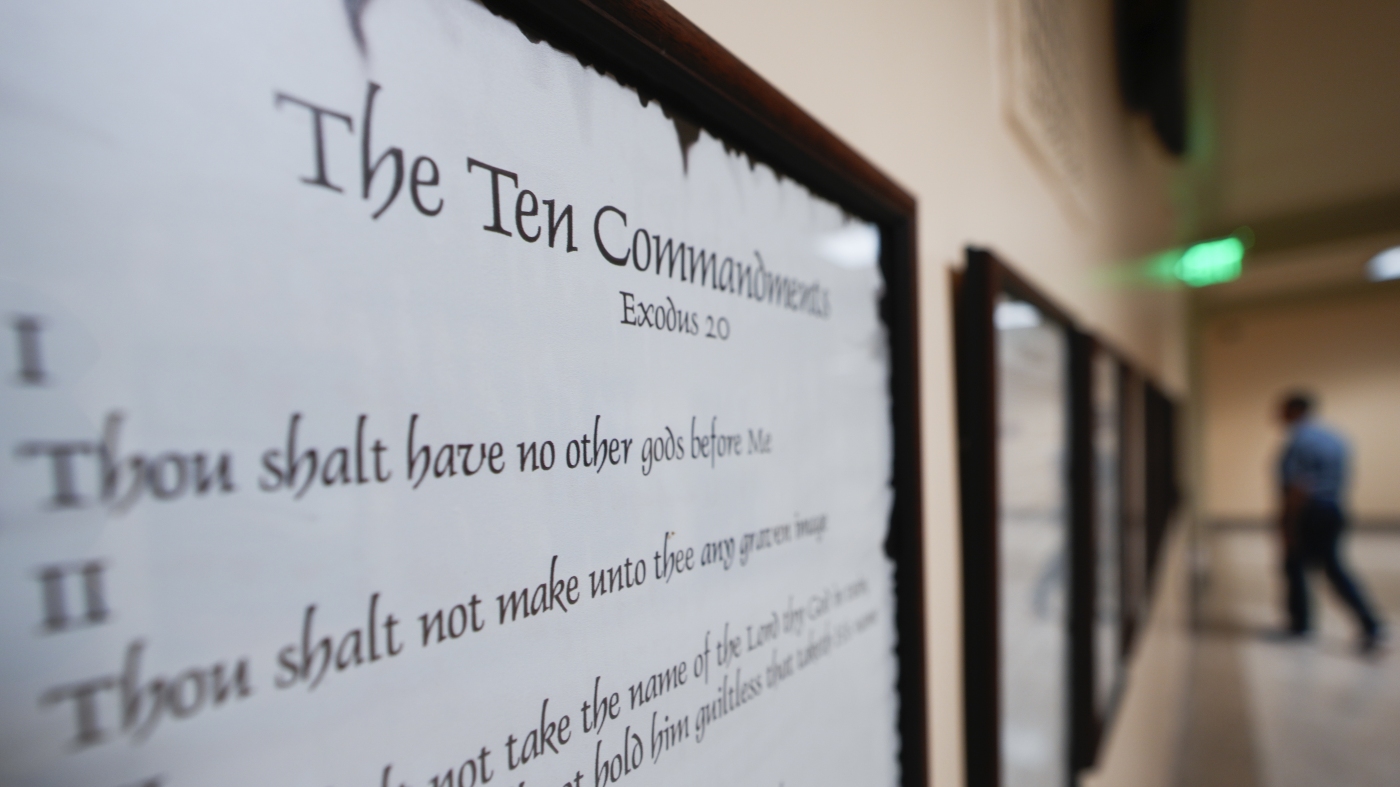

A copy of the Ten Commandments is posted along with other historical documents in a hallway at the Georgia Capitol in Atlanta on June 20, 2024. On Friday, a panel of federal appellate judges ruled that a Louisiana law requiring the Ten Commandments to be posted in the state’s public school classrooms is unconstitutional.
John Bazemore/AP
hide caption
toggle caption
John Bazemore/AP
NEW ORLEANS — In a significant legal decision, a trio of federal appellate judges declared a Louisiana statute unconstitutional. This law mandated that the Ten Commandments be displayed in every public school classroom across the state.
This decision represents a noteworthy triumph for civil liberties advocates who argue the requirement breaches the constitutional separation of church and state. Critics also highlight the potential for these displays to alienate non-Christian students.
The law, supported by several Republicans, including President Donald Trump, is part of a broader conservative effort to integrate religious elements into educational settings. Proponents claim the Ten Commandments hold historical significance and form the basis of American legal principles.
“This is a resounding victory for the separation of church and state and public education,” asserted Heather L. Weaver, a senior staff attorney with the American Civil Liberties Union. “With today’s ruling, the Fifth Circuit has held Louisiana accountable to a core constitutional promise: Public schools are not Sunday schools, and they must welcome all students, regardless of faith.”
There is a dispute over the breadth of the appeals court’s decision, with differing opinions on whether it impacts all public school districts in Louisiana or solely those involved in the lawsuit.
“All school districts in the state are bound to comply with the U.S. Constitution,” stated Liz Hayes, from Americans United for Separation of Church and State, which co-represented the plaintiffs. She added, “Thus, all school districts must abide by this decision and should not post the Ten Commandments in their classrooms.”
Louisiana plans to appeal the ruling
Louisiana Attorney General Liz Murrill expressed her disagreement, believing the ruling pertains only to the five parishes involved in the legal challenge. She indicated plans to appeal, potentially taking the matter to the U.S. Supreme Court.
The panel of judges in this case was unusually liberal for the 5th U.S. Circuit Court of Appeals, with two of the three judges appointed by Democratic presidents, despite the court’s overall conservative composition.
The legal challenge originated from a lawsuit by parents of Louisiana students from diverse religious backgrounds. They argued the law contravenes the First Amendment, which ensures religious freedom and prohibits government establishment of religion.
The decision reaffirms an earlier order by U.S. District Judge John deGravelles, who had previously determined the law unconstitutional and instructed state education officials to cease enforcement and notify school boards statewide.
The mandate was enacted by Republican Gov. Jeff Landry in June. Gov. Landry expressed support for the attorney general’s intention to contest the ruling.

“The Ten Commandments are the foundation of our laws — serving both an educational and historical purpose in our classrooms,” said Landry.
Legal experts anticipate the case may reach the U.S. Supreme Court, offering a significant test of the judiciary’s stance on religion’s role in government.
Similar statutes face legal challenges in other states. Arkansas families recently initiated a lawsuit against a comparable law, while a Texas version awaits gubernatorial approval.
Historically, the U.S. Supreme Court has addressed similar issues. In 1980, it struck down a Kentucky law under the Establishment Clause, and in 2005, ruled against Ten Commandments displays in Kentucky courthouses, while allowing one at the Texas state Capitol.