Miracle Baby: The Remarkable Journey of Nash Keen
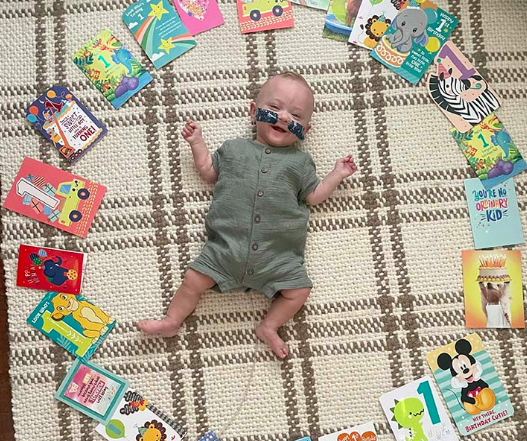
(Photo: Guinness World Records)
In a world where every breath counts, Nash Keen’s survival story stands out as a testament to both the miracles of modern medicine and unyielding faith. Born at a mere 21 weeks, Nash has not only defied expectations but has set a new record, marking his first birthday in a manner few could have anticipated.
Nash entered the world on July 5, 2024, a staggering 133 days premature, and weighed only 10 ounces — the weight of a typical soap bar. His arrival was fraught with uncertainty, as his mother, Mollie Keen, expressed her concerns to Guinness, sharing how she and her husband, Randall, were unsure if Nash would survive the critical early hours.
“But we wanted to give him the best chance,” Mollie reflected, highlighting their determination despite past heartache. Just two years prior, they had mourned the loss of their daughter, McKinley, who was born at 18 weeks.
Their cautious optimism was met with divine intervention, as Nash was delivered in Iowa City at the University of Iowa Health Care Stead Family Children’s Hospital. There, he was immediately placed in the neonatal intensive care unit (NICU), embarking on a six-month battle for survival.
Despite facing numerous medical hurdles such as feeding and breathing issues and a minor heart abnormality, Nash demonstrated what Dr. Amy Stanford, a neonatologist, described as “remarkable resilience” and an “extraordinary” will to fight.
Nash’s perseverance did not go unnoticed. Earlier in the year, he was officially recognized by Guinness World Records as the world’s most premature surviving baby, breaking the previous record by just one day. His survival was celebrated as a victory over “phenomenal odds.”
For the Keen family, the true triumph was witnessing Nash’s development milestones, such as smiling and rolling over. Randall Keen shared with Guinness, “Nash is going to be able to … say, ‘You know what? I came into this world fighting and I’m going to leave fighting.’”
The family celebrated Nash’s milestone birthday in Ankeny, Iowa, surrounded by close friends. The gathering was filled with gifts, including diapers and a Guinness certificate. Yet, for Mollie, the most precious gift is seeing Nash every day. “He’s truly … the best thing that could have happened to us,” she told The Guardian.
While Nash continues to require oxygen and is fed through a tube, his future appears hopeful, thanks to ongoing medical support. His story is part of a broader trend of increased survival rates among extremely premature infants, made possible by advancements in neonatal care.
In an often uncertain world, Nash Keen’s journey offers a poignant reminder of resilience and grace.
This article was originally written by www.christiantoday.com