Falling Birthrates Challenge Greek Island Communities
Amidst the serene beauty of the Greek island of Lemnos, a quiet crisis unfolds as student numbers dwindle and schools face closure. This demographic shift highlights the broader global trend of smaller families and its profound impacts on local communities.
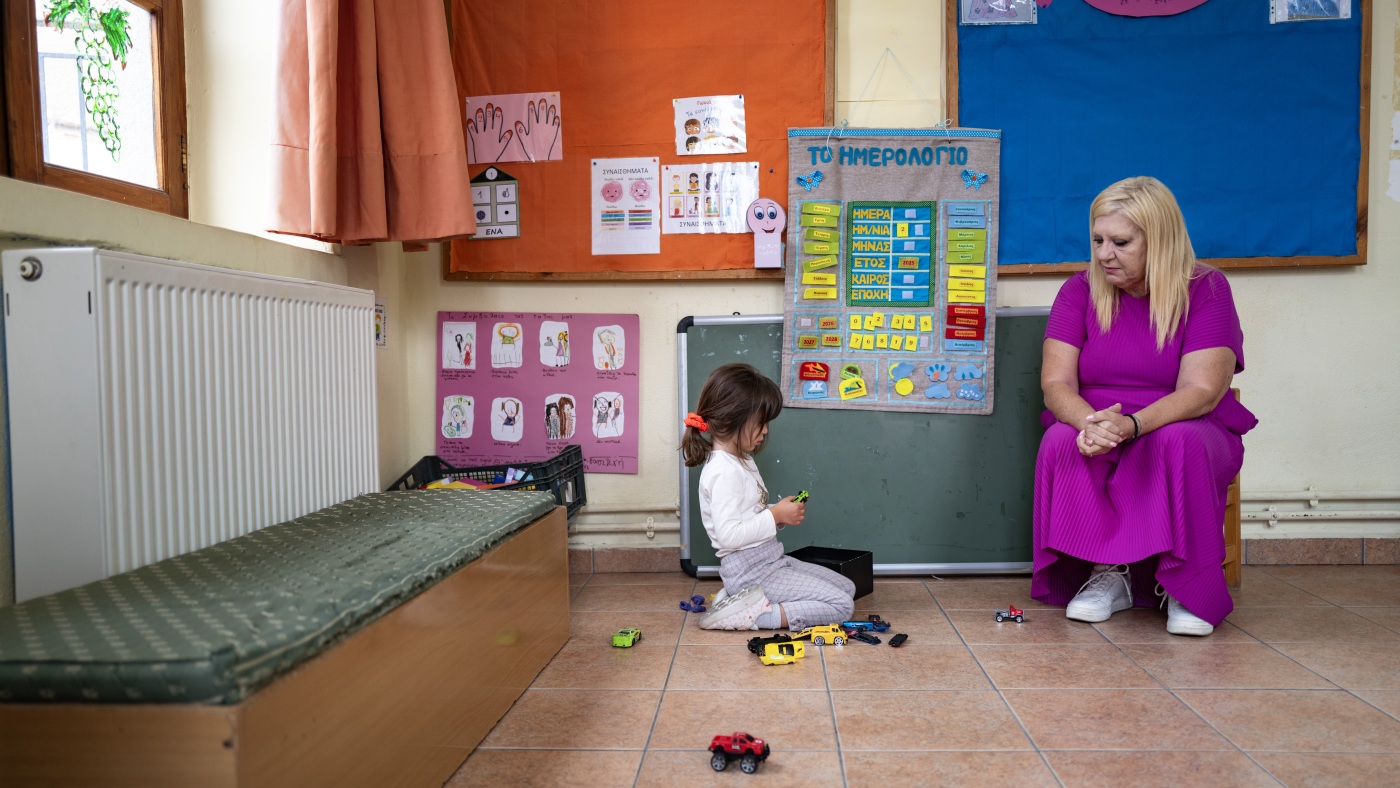
In the small village of Thanos, 4-year-old Vasiliki Vourgou finds herself the sole student in her kindergarten class due to declining enrollment. Her teacher, Maria Kokkinopliti, hopes to encourage social interaction by integrating the young pupils with older children during breaks. “They wait for the kids from the primary school to get out and they join them also, so they can be more social,” Kokkinopliti shares through an interpreter.
Lemnos, home to about 16,000 residents, faces a shrinking population as younger generations migrate and those remaining have fewer children. Vasiliki’s father, Stelios Vourgos, remains committed to island life, despite the challenges. “Here, I fell in love with my wife; here is my job,” he explains. “For the kids, it’s a paradise to be raised on an island, because big cities are like a jungle.”
Despite the idyllic setting, the island’s primary school numbers are dropping, echoing a nationwide trend. Greece’s birthrate hovers around 1.3 births per woman, far below the replacement rate needed to sustain the population. This demographic decline has led to the closure of over 700 schools across the country this year, as reported by the Greek education ministry (source).
Health care and infrastructure limitations further exacerbate the issue. Konstantinos Maditinos, president of the primary education teachers association on Lemnos, notes the lack of incentives for young couples to stay. “This means young couples have little incentive to stay on the island and leave, even if they are originally from here,” he says.
Pediatrician Dr. Olga Katira has observed the declining birthrate firsthand. “We used to have six, seven newborns per month, and now we have three,” she remarks. Her concerns mirror those of many, as the nation’s aging population poses long-term challenges.
On the neighboring island of Thymaina, Katerina Vrana embodies the struggles faced by parents in remote communities. With limited local healthcare options, Vrana relied on the Athens-based nonprofit HOPEgenesis, which provides financial aid for medical care and transportation. This support made her dream of a third child possible.
Despite this assistance, the difficulties of island life remain. Thymaina’s primary school has only two students, prompting Vrana to send her youngest to a neighboring island by ferry to avoid solitary schooling. Similar sentiments are echoed by 16-year-old Georgia Gramatikou, who foresees limited opportunities on her island home.
The demographic shift is not just a local issue but a national concern, with implications for Greek identity and culture. Angelos Vlapas, principal of a Lemnos primary school, voices concerns about immigration’s impact on Greek identity. “We’re not criticizing the people who came here to make a living,” he states, but acknowledges the complexities introduced by diverse nationalities.
Economic demographer Alexandra Tragaki highlights societal role shifts as a contributing factor to the declining birthrate. “Women changed roles, but no one else did,” she observes, noting the dual pressures of career and family that lead to smaller family sizes.
In the picturesque setting of Fourni, elderly residents like Nikolaos Amorgianos reminisce about past family dynamics. “In 10 years, Greece will be a country of old people,” he predicts, attributing changes to shifting values among younger generations.
Despite these challenges, local business owner Dimitris Markakis remains hopeful. “Greek people are very hard, and they always face problems with responsibility,” he affirms. “I am optimistic.”