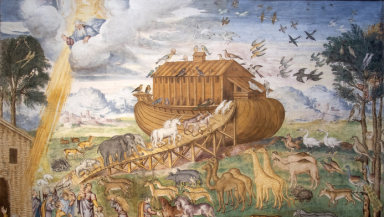
The ancient tale of Noah’s Ark remains one of the most enduring narratives from the Bible, captivating generations through various retellings in books, films, and songs. Despite its widespread familiarity, many details about this iconic story remain shrouded in mystery and conjecture.
Understanding the Ark
In the book of Genesis, chapters 6 to 8, Noah’s ark is described. The term “ark” stems from the Latin word “arca,” akin to a box or chest. This term also applies to the “ark of bulrushes” that carried Moses and the “ark of the covenant” (Exodus 25:10). While generally perceived as a boat, the ark’s connotation aligns more closely with that of a container.
The Deluge: Theories and Timing
The flood narrative in Genesis 7:11 depicts a catastrophic inundation brought about by divine forces opening “all the springs of the great deep” and the “floodgates of the heavens.” Various theories speculate on its cause, ranging from cloudbursts and ice cap melting to tsunamis. Some suggest the flood might align with the Black Sea breaching the Bosphorus. Dating this deluge is speculative, with estimates ranging from 2348 BC to as far back as 5500 BC, depending on interpretations of biblical genealogies and historical records.
Materials and Construction
The ark’s construction is described in Genesis 6:14: “Make thee an ark of gopher wood; rooms shalt thou make in the ark, and shalt pitch it within and without with pitch” (KJV). The term “gopher” remains undefined, leading to diverse interpretations, including cedar or cypress wood. Some parallels with Moses’ pitch-coated basket suggest a possible reed construction, akin to ancient reed boats used by the Marsh Arabs of southern Iraq.
Dimensions and Shape
Genesis 6:15 provides the ark’s dimensions as 300 cubits long, 50 cubits wide, and 30 cubits high. However, these figures do not clarify the ark’s shape, leading to interpretations ranging from rectangular boxes to boat-like structures. The ambiguity extends to the cubit measurement itself, whose length can vary based on the forearm of the measurer.
Final Resting Place
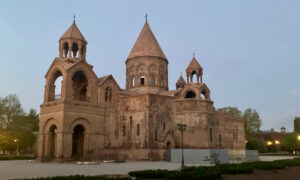
Genesis 8:4 mentions the ark coming to rest on the “mountains of Ararat,” though the Bible does not specify Mount Ararat itself. Instead, the name “Ararat” refers to a region, identified with present-day Armenia in southwest Türkiye. Tradition and archaeological efforts have focused on Mount Ararat, but volcanic activity and other factors complicate the search.
Animal Passengers
Genesis 7:2–3 differentiates between clean and unclean animals, with the former taken in sevens and the latter in pairs. The concept of clean and unclean animals predates Levitical law, adding complexity to understanding the ark’s passengers. The number of animals also hinges on the flood’s geographic scale—regional or global.
Extent of the Flood
The biblical flood is described in terms that suggest global coverage, yet interpretations vary. The term “earth” in Genesis might refer to land rather than the entire planet, as other biblical hyperbolic usages demonstrate. This contextual reading allows for a regional flood interpretation, aligning with some evangelical perspectives.
Evolutionary Considerations
A global flood necessitating the preservation of all animal species poses logistical challenges. Some propose that the ark housed representative “kinds,” from which modern biodiversity evolved, a hypothesis requiring rapid post-flood speciation and migration.
Survivability of the Ark
Whether Noah’s ark survived is unknown. Natural decay, recycling, or volcanic activity might have led to its disappearance. Unlike other biblical landmarks, no mention of its survival exists, leaving its fate a subject of speculation.
Despite the uncertainties surrounding the story, Noah’s Ark continues to inspire exploration and debate. Recent interest in a geographical anomaly in southeastern Türkiye, posited as the ark’s remains, illustrates the enduring allure of this ancient narrative. Discoveries could shed light on longstanding questions or challenge existing interpretations.
This article was originally written by www.christiantoday.com