Ancient Cross Discovery Sheds New Light on Early Christianity in the Arabian Gulf
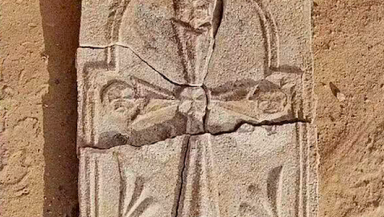
On the serene Sir Bani Yas Island in Abu Dhabi, archaeologists have uncovered a 1,400-year-old cross, sparking new insights into the spread of Christianity in the seventh and eighth centuries. This discovery challenges previous beliefs and indicates a vibrant Christian community that thrived amidst the emergence of Islam and the persistence of pagan traditions.
Embedded within the ruins of an ancient church and monastery, the plaster plaque features a cross designed with a stepped pyramid base, symbolizing Golgotha, the site of Jesus’s crucifixion, and adorned with foliage. This suggests a flourishing Christian presence in the region, contradicting earlier assumptions of the religion’s decline during this era, as reported by The National.
Maria Gajewska, the lead archaeologist, noted, “Every element of the cross incorporates regional motifs. It tells us that Christianity in this region was not only present but flourished, adapting visually to its local context. We had settlements of Christians that were not just existing but were clearly thriving.”
Measuring approximately 27 cm by 17 cm and less than 2 cm thick, the cross likely served a sacred purpose, potentially mounted on a wall for worship. Additional artifacts found at the site include pottery, glass vessels, and a small sea-green bottle, possibly for oil or rosewater.
Among the intriguing discoveries, Hager Al Menhali, an Emirati archaeologist, observed “a distinct fingerprint on the back” of the plaque, potentially left by its creator over a thousand years ago.
Mohamed Khalifa Al Mubarak, chairman of the Department of Culture and Tourism, emphasized the discovery as “a powerful testament to the UAE’s profound and enduring values of coexistence and cultural openness,” highlighting the region’s historical religious diversity.
The community on Sir Bani Yas was likely connected to the Church of the East, a denomination with influence extending from the Middle East to India and China. The settlement housed high-ranking monks in well-constructed limestone and coral homes equipped with water cisterns, reflecting a lifestyle dedicated to worship and contemplation.
Initial signs of Christianity on the island appeared in the early 1990s. More recent finds include a second monastery in Umm Al Quwain in 2022, alongside related sites in Kuwait, Iran, and Saudi Arabia.
The reasons behind the eventual decline of the Sir Bani Yas settlement remain uncertain, as the structures show no signs of collapse or violence. Researchers speculate that the inhabitants may have left voluntarily with plans to return.
Historical accounts suggest peaceful coexistence between early Christians and Muslims in the area, marked by trade and interaction. This discovery offers a rare glimpse into Christianity’s eastward journey, underscoring the Arabian Gulf’s pivotal role in the broader narrative of the faith’s spread across Asia.
This article was originally written by www.christiantoday.com