
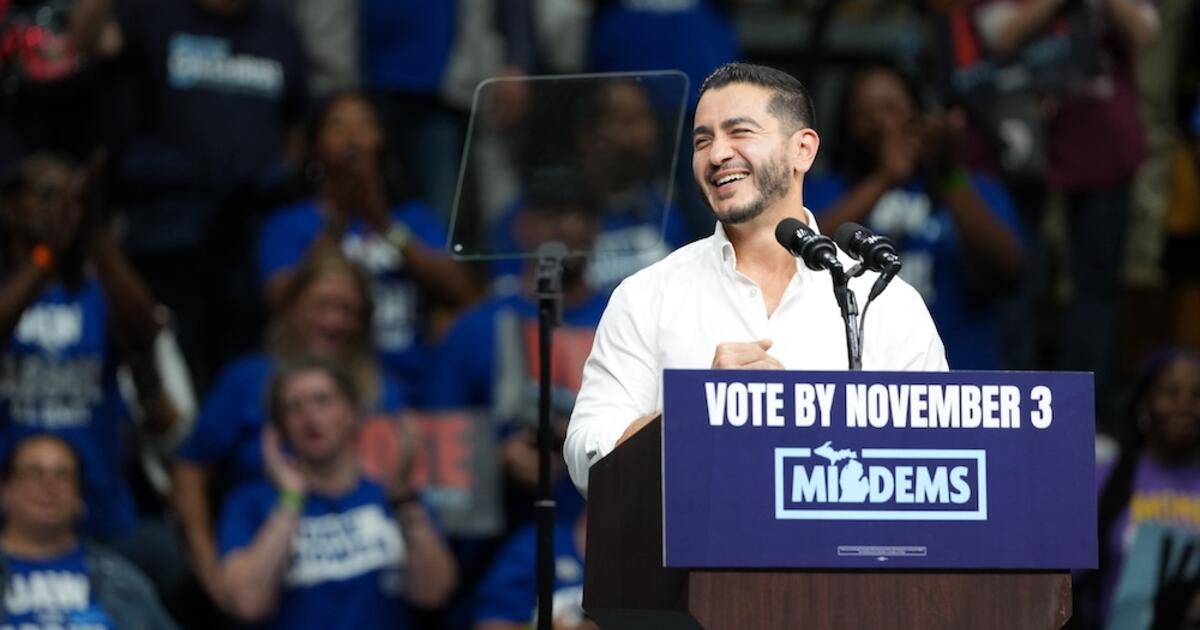
In an event that has sparked widespread discussion, Abdul El-Sayed, a Democratic Senate candidate, faced Islamophobic accusations during a town hall in Caro, Michigan. This incident reflects the tense political climate as Republicans intensify their focus on religious and cultural issues ahead of upcoming elections.
During the town hall, Thomas Teepell, a former aide to Republican Senator Josh Hawley, questioned El-Sayed’s loyalty by demanding he disavow the Muslim Brotherhood. El-Sayed’s response highlighted the underlying assumptions of such questions, drawing parallels to historical prejudices faced by other religious minorities.
El-Sayed’s calm rebuttal emphasized the importance of the U.S. Constitution as a guiding principle that guarantees freedom of religion. He pointed out that such questions stem from an exclusionary mindset similar to the scrutiny faced by John F. Kennedy, the first Catholic president, regarding his allegiance to the pope.
In a back-and-forth exchange, El-Sayed challenged Teepell’s assumption that his faith might undermine his allegiance to the Constitution. El-Sayed asked Teepell about his religious beliefs, to which Teepell replied he was a Christian. El-Sayed then underscored the constitutional right to religious freedom, questioning whether Teepell would disavow integrating religious doctrine into U.S. laws.
Teepell’s negative response to this question exposed a broader issue within the Republican Party, where Christian nationalism is increasingly influencing political discourse. Figures such as Defense Secretary Pete Hegseth and Paula White-Cain, head of the White House Faith Office, exemplify this trend. Senator Hawley himself has advocated for a version of Christian nationalism in his public speeches.
The incident at the town hall also highlights the challenges faced by Jewish communities, who often find themselves caught between Christian nationalist policies and accusations of dual loyalty. Critics argue that opposition to Israel is frequently misconstrued as antisemitism, overshadowing the dangers of Christian nationalism.
As the political landscape evolves, El-Sayed’s experience serves as a reminder of the need to uphold constitutional values that protect religious diversity. The rhetoric employed by figures like Teepell, Mike Rogers, and Donald Trump underscores the risks of allowing religious bias to shape American politics.
El-Sayed’s stance against military aid to Israel, a nation accused of genocide in Gaza, has drawn criticism from some within the Jewish and Christian communities. However, the overtly bigoted rhetoric from certain Republican figures highlights the potential consequences of supporting a party aligned with Christian nationalist ideals.
As Martin Niemöller’s famous words caution, the failure to address growing intolerance can have dire consequences. El-Sayed’s stand at the town hall is a call to action for those who value religious freedom and diversity in America. The Constitution remains a cornerstone for protecting these rights against the encroachment of religious extremism.
If Christian nationalists are allowed to define America as a Christian country in which Muslims are viewed as alien outsiders, it won’t be long until Jews, Catholics, atheists, and anyone expressing political dissent will also be labeled as alien outsiders.
This article was originally written by sojo.net



Comments are closed.