
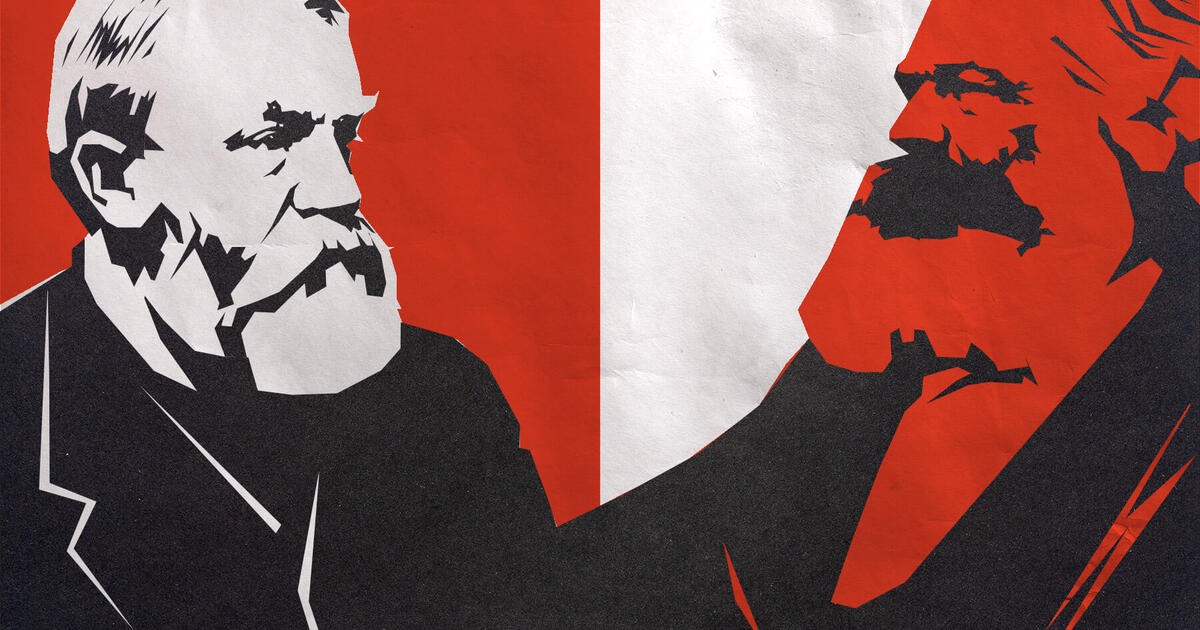
Amid rising discussions on political ideologies, a new book titled Marx and Moody by Erwin W. Lutzer and Gregg Quiggle has entered the fray, examining the divergent paths of Karl Marx and Dwight Lyman Moody. This work by former Moody Church pastor and former Moody Bible Institute professor unpacks the clash between socialist ideals and evangelical convictions.
Evangelical leaders such as Franklin Graham, Al Mohler, Mark Driscoll, and Josh Howerton have voiced concerns over what they view as an impending “socialist storm,” fearing it threatens traditional values. These concerns have intensified as Democratic Socialists have seen an upswing in public support. The historical context of these fears stretches back to the Cold War, where figures like Billy Graham emphasized “Americanism” as a counter to communism, aligning with free-market capitalism.
The critique of socialism, particularly its portrayal as a precursor to godless communism, has a long history in American evangelical circles. The book Marx and Moody continues this narrative, urging readers to choose between what the authors describe as good over evil—favoring Moody over Marx.
Moody’s Legacy
Gregg Quiggle explores the life and social activism of Dwight Lyman Moody, tracing his journey from modest beginnings in Northfield, Massachusetts, to becoming a prominent religious figure. Moody’s early life was marked by financial struggles, but his conversion to Christianity in Boston under Edward Kimball’s guidance led him to Chicago, where he sought wealth as a shoe salesman. Despite his pursuit of wealth, Quiggle asserts that Moody maintained his focus on serving the poor.
In 1858, Moody established a Sunday school in a Chicago neighborhood reportedly populated by “the poorest and most wretched class,” although the historical accuracy of this demographic is debated. Moody’s leadership in the Chicago Young Men’s Christian Association expanded its efforts among the working class, and he later founded educational institutions including the Moody Bible Institute.
Quiggle acknowledges some of Moody’s controversial actions, such as segregating Southern revivals and not addressing labor and racial issues more robustly. However, Quiggle’s portrayal often leans towards a sympathetic view, citing evangelical biographers and primary sources that align with Moody’s mission.
Marxist Philosophy
Contrasting Moody, Karl Marx is depicted as an antagonist in evangelical circles. Billy Graham referred to Marx’s ideology as “Satan’s religion,” and Lutzer echoes this sentiment in Marx and Moody. Lutzer describes Marxism as a philosophical and moral threat, warning that it seeks to replace faith in God with faith in the state.
Marx’s critique of religion as “the opium of the people” and his views on class struggle are seen as adversarial to the gospel. Despite this, figures like Gustavo Gutiérrez in the Global South have embraced aspects of Marxist theory to advocate for social justice within a Christian framework. Liberation theology, inspired by Marxist ideas, sees class struggle as a reality to confront in solidarity with the oppressed.
Historical instances of U.S.-backed capitalism’s influence in regions like Latin America and the Philippines demonstrate the complexities in the interplay between religion and political ideologies. Many Christians in these areas have identified capitalism as a force against which they must struggle, using Marxism as a tool for social analysis and transformation.
While Marx and Moody presents a critical view of Marx, it overlooks the nuanced relationship between Marxist thought and religious activism. Some scholars argue that Marx’s ideas were influenced by Jewish traditions, aiming for a just social order that aligns with the prophetic hope seen in scripture.
The book offers a limited critique of Moody, often avoiding deeper engagement with opposing scholarship. In contrast, Marx’s philosophy, though polarizing, continues to inform discussions on social justice, challenging Christians to consider the economic systems that drive inequality.
Ultimately, the debate between Marx and Moody represents broader tensions between socialism and evangelical Christianity, with each side offering differing visions for addressing social and economic injustices. As the conversation evolves, the dialogue between these ideologies continues to shape perspectives on faith and politics.
This article was originally written by sojo.net




Comments are closed.