(Photo: Getty/iStock)
The writer of the Letter to the Hebrews reminds Christians that they are surrounded by a great “cloud of witnesses.” (NRSV) That “cloud” has continued to grow in size since then. In this monthly column we will be thinking about some of the people and events, over the past 2000 years, that have helped make up this “cloud.” People and events that have helped build the community of the Christian church as it exists today.
The 16th-century Reformation brought significant challenges to the Roman Catholic Church as Protestant leaders criticized the papacy for perceived theological errors and institutional corruption. They advocated for “sola scriptura,” emphasizing scripture as the highest authority, and rejected practices like the sale of indulgences and veneration of relics. The reformers aimed to restore the purity of early Christianity by opposing the sacramental system and promoting “sola fide,” or justification by faith alone.
This critique suggested a late-medieval Church in the West that was merely awaiting the Reformation. However, the situation was more complex, especially in places like England, where medieval documentation provides insights into the vibrant religious life.
Building for God’s Glory
In 13th-century England, church construction projects were so extensive that, by modern estimations, it was akin to every family contributing over £1,000 annually for these endeavors. This building boom was not merely about competition or seeking divine favor but was a communal expression of faith and devotion to glorify God.
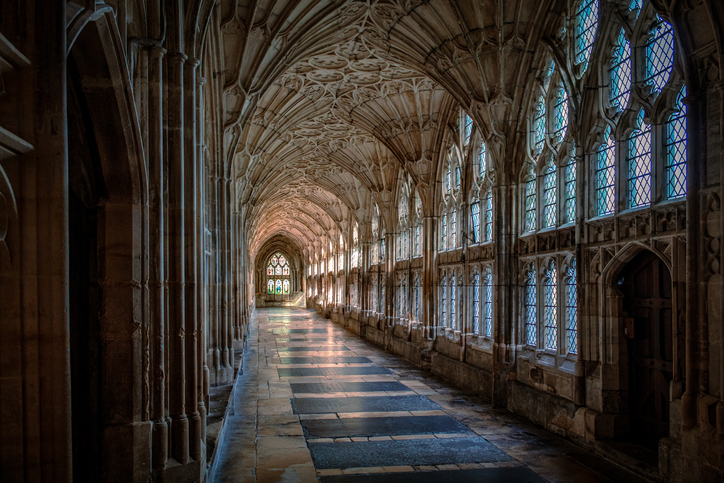
From 1250, English churches evolved architecturally, incorporating elements like bell towers and spires by 1300. The shift to the Perpendicular Style after 1330 resonated with a society grappling with the aftermath of the Black Death, reflecting a spirituality focused on enduring personal faith.
The 15th-century church rebuilding was especially prominent in wealthy wool-producing regions like the Cotswolds and Suffolk. Features such as font covers, rood screens, and stone monuments became more common, and seating with benches and pews was introduced.
Chantry chapels, where Masses were held for the dead, saw increased construction from the late 14th century into the 15th. This trend aligned with the doctrine of purgatory, which gained prominence since the 12th century. Bristol, for instance, had a significant number of parish churches and chantries by the late 15th century, reflecting communities’ efforts to address mortality and the afterlife.
Engagement with Faith, in the Face of Death
The late Middle Ages saw a growing awareness of life’s transience, reflected in tomb carvings depicting decaying corpses. This era’s literature, such as Caxton’s “Arte and crafte to knowe well to die,” underscores the period’s focus on death and spiritual readiness.
Cemeteries served multiple purposes, from religious processions to community gatherings, emphasizing the connection between the living and the dead. The use of coffins became more common in the 14th century, possibly as a response to the Black Death, aiming to preserve bodily integrity for the Final Judgement.
Preaching, Learning, Caring, Reflecting
By 1250, monastic building had slowed, and support shifted to friars who engaged more directly with communities. However, as friars gained wealth, contributions moved to local parish churches where funds could be monitored. Wealthy patrons also funded colleges, blending religious and educational functions.
This period was not a decline in spiritual enthusiasm but a re-focusing of resources and efforts. The number of hermits, often providing spiritual guidance, increased, and figures like Julian of Norwich left lasting legacies with works like “Revelations of Divine Love.”
The Challenge of the Lollards
The Lollards emerged as critics of the Church, with diverse beliefs challenging its power and wealth. Figures like John Wycliffe pushed for reforms and Bible translations, influencing both intellectuals and grassroots movements.
Although Lollards are often seen as proto-Protestants, they highlight the complexity of faith in late-medieval England, where some sought reform while others aimed to deepen faith within existing structures.
Spiritual Crisis or Personal Engagement with Faith?
The English Church’s state in the late 15th and early 16th centuries prompts debate. Evidence of vibrant religious devotion, like the popularity of “Books of Hours” and pilgrimages to relics, suggests a thriving spiritual life despite criticisms.
While pilgrimage declined, local shrines remained significant, and Corpus Christi plays persisted until the Reformation. Art reflected a personal connection with Christ, emphasizing his humanity and suffering.
The English Church on the Verge of the Reformation
By 1500, the English Church faced challenges but was not destined for collapse. The Church’s failure to engage with reform and the impact of Tudor politics contributed to the Reformation. Despite this, the late-medieval Church was dynamic and complex, with a strong spiritual foundation.
Martyn Whittock is an historian and a Licensed Lay Minister in the Church of England. The author, or co-author, of fifty-eight books, his work covers a wide range of historical and theological themes. In addition, as a commentator and columnist, he has written for several print and online news platforms and been interviewed on TV and radio news and discussion programmes exploring the interaction of faith and politics. His books A Brief History of Life in the Middle Ages (2013) and the co-written The Story of the Cross (2021), include exploration of the complex nature of late-medieval Christian faith and practice.
More by Martyn Whittock:
The Christian Churches and the Nazis
The triumph of Christianity over the Viking raiders
The Knights Templar: history, myth, conspiracy
The Christian conversion and the invention of the English
This article was originally written by www.christiantoday.com