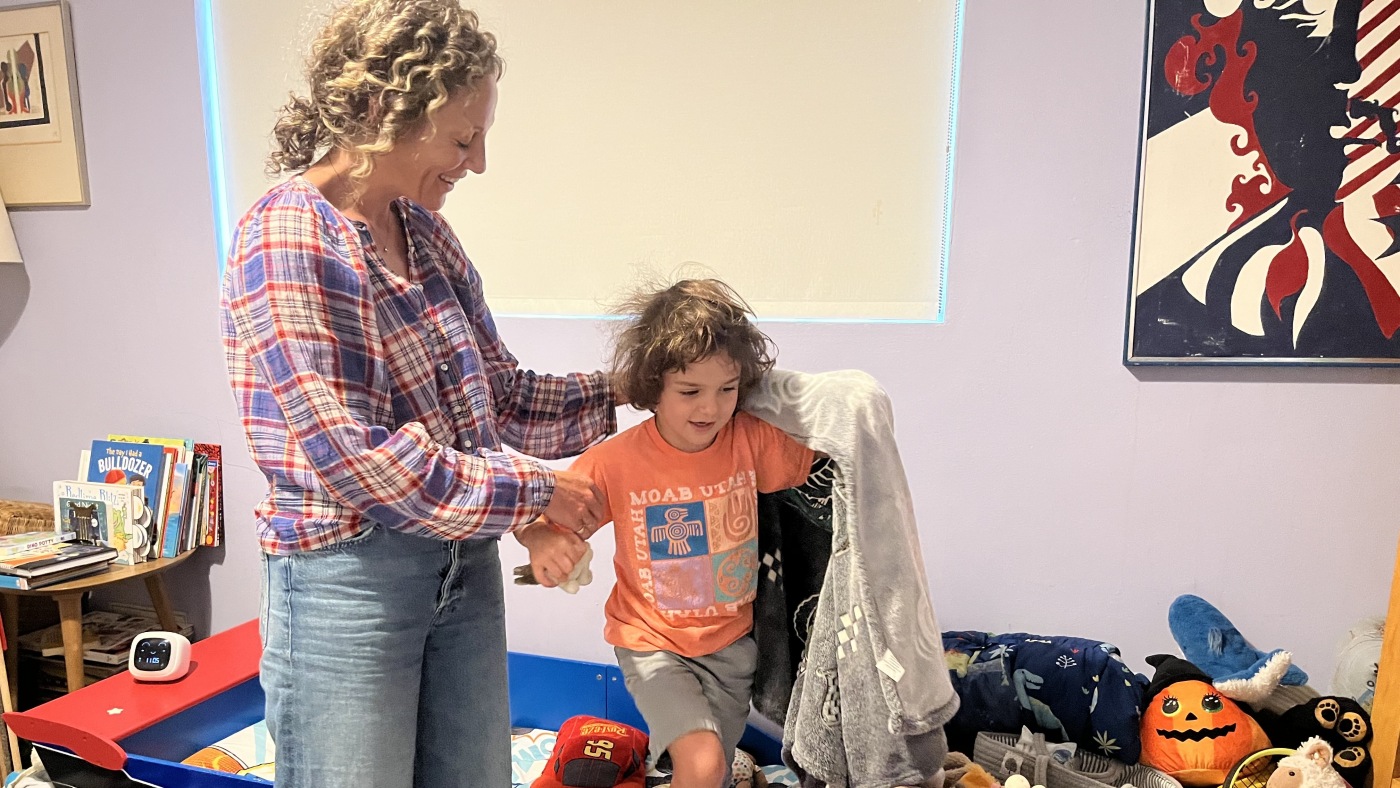

Mollie Sussman and Eli Frankel show off his new race car bed. The 5-year-old is one of 3.6 million children born in the U.S. in 2020 who are starting kindergarten this year.
Vanessa Romo/NPR
Vanessa Romo/NPR
The start of a school journey can often be filled with excitement and anxiety, and for the Sussman and Frankel family, it was no different. Last Wednesday marked the beginning of Eli’s educational path at California Creative Academy, a charter school located in Los Angeles.
“We were super freaked out,” shared Mollie Sussman with NPR, as she recalled the emotions she and her husband, Brad Frankel, experienced. The couple and their son Eli were all apprehensive about this new experience.
Mollie worried about Eli adapting to the transition from a small preschool to a larger elementary school environment, one that included students all the way up to eighth grade. Concerns about potential meltdowns or his ability to adjust to a structured day without naps weighed heavily on her mind.
However, after a smooth start involving a class activity, Mollie and Brad left the classroom without issue. “He was ready when we left. He did really well and he was super brave,” Mollie said, even noting with humor that her husband was the only one who shed tears.
Eli is among the 3.6 million children born in 2020 who are embarking on their educational adventures this year. These children were born amidst the challenges of the COVID-19 pandemic, surrounded by masked individuals and immersed in a world of hand sanitizers. Their early years were shaped by lockdowns and limited social interactions, leaving questions about long-term impacts.

A woman stops to view a public art installation aimed at turning boarded-up shopfronts into works of art in Los Angeles on April 28, 2020.
Frederic J. Brown/AFP via Getty Images
Frederic J. Brown/AFP via Getty Images
According to a 2023 study in the Journal of the American Medical Association Pediatrics (JAMA Pediatrics), early childhood experiences can profoundly affect long-term growth and development. While positive nurturing enhances cognitive and academic progress, negative early-life experiences can result in deficits in coping with stress and self-esteem. This has led parents and educators to closely monitor the potential effects of the pandemic on children’s development.
“Just being in utero during a highly stressful time had some developmental effects on infants,” explained Dani Dumitriu, a pediatrician and neuroscientist at Columbia University. Her ongoing research indicates that while these effects were not large, they are concerning given the number of births during the pandemic period.
Dumitriu’s 2022 research highlighted that infants born during the pandemic’s early months experienced slight delays in motor and social skills compared to those born before the pandemic. However, the good news is that these children have shown remarkable recovery and catch-up over time.
Eli’s journey
Mollie Sussman noticed that Eli’s speech development wasn’t aligning with expected milestones when he was about two years old. “There were for sure a number of words you should know by a certain time and he didn’t know them,” she said. This aligns with a 2023 study that found a significant rise in speech delay diagnoses among children aged two during the pandemic.
Seeking early intervention, Sussman enrolled Eli in speech therapy. Many children have been showing similar speech development challenges due to reduced exposure to facial expressions during the pandemic. Eli’s speech improved significantly by age three, thanks to timely support.
Pandemic behaviors and habits that can spell trouble for kindergartners
Beyond developmental concerns, pandemic-related behaviors can also impact children. Increased parental stress and elevated screen time can be detrimental to readiness for school. A study in the journal Nature highlighted the negative effects of screen time on young children, including behavioral issues and delayed milestones.
School attendance has also been affected. The U.S. Department of Education’s recent report indicated a rise in chronic absenteeism rates, with 28% of students missing significant school time during the 2022-2023 year.
Kristen Huff of Curriculum Associates noted that current kindergarteners, even those not in school during the pandemic, are less prepared compared to pre-pandemic peers. The company’s 2025 State of Student Learning report revealed a decline in kindergarten readiness, particularly in math and reading.
Despite these challenges, Huff remains optimistic. She emphasized the importance of providing the necessary resources and support to enable students to thrive and regain lost academic ground.