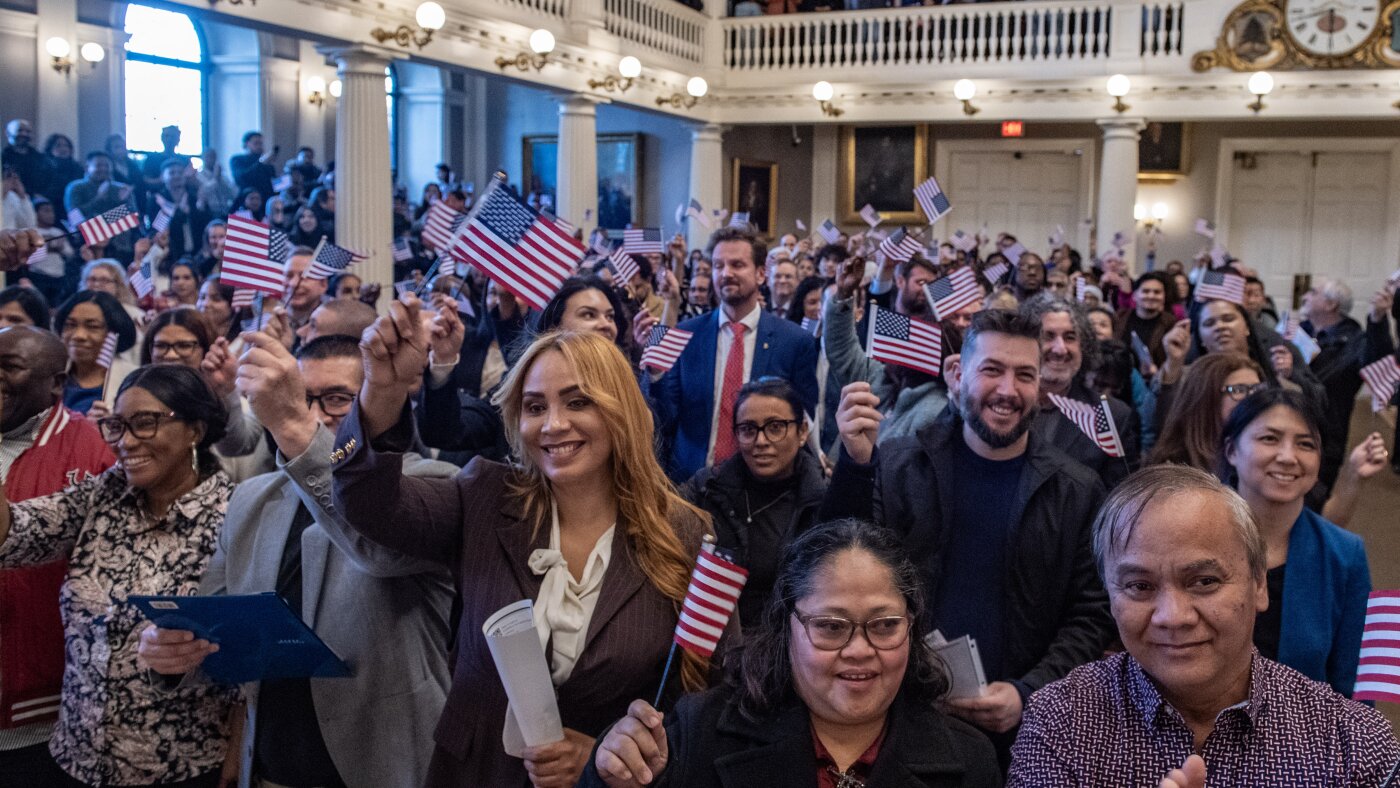

New U.S. citizens take part in a naturalization ceremony at Faneuil Hall in Boston on Jan. 8.
Joseph Prezioso/AFP via Getty Images
hide caption
toggle caption
Joseph Prezioso/AFP via Getty Images
Stay up to date with our Politics newsletter, sent weekly.
The landscape of U.S. citizenship applications has seen significant shifts due to changing immigration policies. Johanan Rivera, an immigrant residing in the U.S. for 15 years, illustrates this trend as he chose to become a U.S. citizen in response to political changes. Despite initial reluctance, the desire for certainty prompted his naturalization.
In February 2025, Rivera and many others sought to secure their status amidst heightened immigration scrutiny under President Trump’s administration. This political climate drove Rivera to apply for naturalization, aiming for “more certainty about being able to live in the same country” with his partner.
Data from the U.S. Citizenship and Immigration Services (USCIS) highlights the fluctuations in naturalization applications and approvals throughout 2025. While the year commenced with a surge in applications, the latter half witnessed a decline, both in applications and approvals.
Experts attribute these trends to the stringent immigration policies enforced during Trump’s presidency. Felicia Escobar Carrillo, former USCIS chief of staff, noted the pervasive fear among immigrants, causing hesitation in pursuing citizenship.
Despite the initial spike in naturalizations, with a record 88,488 approvals in a single month, the numbers dwindled by January 2026. The drop in citizenship approvals aligns with a decrease in applications, reflecting uncertainty and diminished trust in the immigration system.
Margy O’Herron from the Brennan Center for Justice commented on the administration’s efforts to define American identity through naturalization policies, emphasizing the control over granting citizenship.
USCIS has implemented more rigorous screening processes, including the reintroduction of neighborhood investigations, to ensure applicants meet the criteria for citizenship. These measures, according to USCIS spokesman Matthew Tragesser, aim to uphold “order, security, integrity, and accountability.”
Theresa Cardinal Brown, an immigration consultant, suggested that political factors, particularly Trump’s campaign promises, spurred some to apply for citizenship early in 2025. The urgency to secure their status led many to pursue naturalization.
However, the tightening of naturalization procedures has led to a notable decline in applications. By late 2025, fewer immigrants were applying, and approvals continued to decrease.
The administration’s focus on “America First” policies and the ongoing scrutiny have contributed to a cautious approach among potential citizens. For some, like Daniel Chigirinsky, the process has become a source of anxiety amid changing rules.