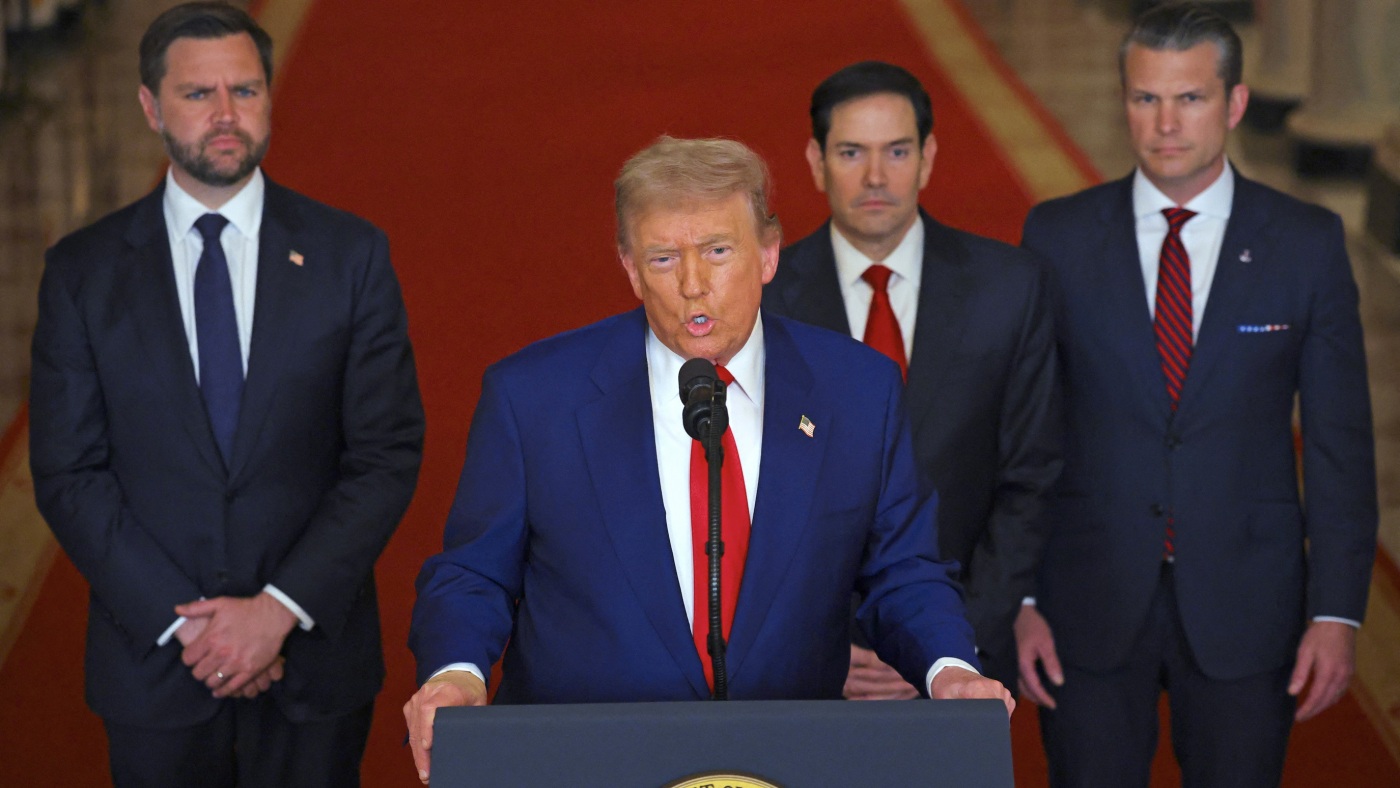

President Trump addresses the nation, alongside US Vice President JD Vance (L), US Secretary of State Marco Rubio (2nd R) and US Secretary of Defense Pete Hegseth (R), from the White House on Saturday.
Carlos Barria/Pool/AFP via Getty Images
Carlos Barria/Pool/AFP via Getty Images
The ongoing tensions between the U.S. and Iran reached new heights as the U.S. military teamed up with Israel for a series of strikes aimed at Iran’s nuclear facilities. The campaign marks a significant step in the efforts to curb Tehran’s nuclear ambitions.
President Trump, via a Truth Social post, announced, “We have completed our very successful attack on the three Nuclear sites in Iran, including Fordow, Natanz, and Esfahan.”
He further noted, “All planes are now outside of Iran air space. A full payload of BOMBS was dropped on the primary site, Fordow. All planes are safely on their way home. Congratulations to our great American Warriors. There is not another military in the World that could have done this. NOW IS THE TIME FOR PEACE! Thank you for your attention to this matter.”
Later that evening, Trump addressed the nation from the White House, flanked by Vice President JD Vance, Secretary of State Marco Rubio, and Defense Secretary Pete Hegseth. “Our objective was the destruction of Iran’s nuclear enrichment capacity and a stop to the nuclear threat,” Trump said. “Tonight I can report to the world that the strikes were spectacular military success. Iran’s key nuclear enrichment facilities have been completely and totally obliterated.”
Trump emphasized a desire for peace but warned, “If peace does not come quickly, we will go after those other targets with precision, speed and skill.” More details are expected from the Pentagon at a press conference scheduled for 8 a.m. ET Sunday.
This military operation represents the first direct involvement of the U.S. in the escalating conflict between Iran and Israel. The primary target of the strike was the fortified Fordow nuclear site, a location known for its depth beneath a mountain and its proximity to Tehran.
A U.S. official, speaking on condition of anonymity, revealed that senior Democratic leaders were informed of the operation shortly before Trump’s announcement, while the Army Ops Center simultaneously notified senior Army personnel. The timing of Republican leaders’ notification remains unclear.
Democratic leaders, including Rep. Jim Himes, voiced strong opposition. Himes stated, “Donald Trump’s decision to launch direct military action against Iran without Congressional approval is a clear violation of the Constitution, which grants the power to declare war explicitly to Congress.” He also expressed uncertainty about the operation’s success.
A turning point
Although President Trump had consistently promised to avoid further Middle East conflicts, the threat posed by Iran’s nuclear capabilities pushed him to act. Initially, Trump sought a new deal to replace the previous nuclear agreement with Iran. However, escalating tensions following Israeli airstrikes shifted his stance.
Trump has urged Iran to surrender unconditionally and has asserted U.S. air superiority over Iran. In a separate post, he warned Ayatollah Ali Khamenei of the U.S.’s awareness of his location, though he stressed there are no immediate plans to target him.
In response, Khamenei warned on X that U.S. military involvement would be detrimental to America, with potentially “irreparable” consequences.
A new phase of uncertainty
Though ground troops have been ruled out by Trump, the airstrikes signal a new phase in the conflict, which initially began with Israeli air operations against Iran. The intent, according to Israel, is to prevent Iran from obtaining nuclear weapons, though Iran claims the strikes have resulted in civilian casualties.
In retaliation, Iran launched missile and drone attacks on Israel, causing casualties despite Israel’s defense systems intercepting many missiles. Prime Minister Benjamin Netanyahu maintains that Iran’s nuclear ambitions are a threat to both Israel and the U.S.
The U.S. intelligence community, as recently as March, maintained that Iran suspended its nuclear weapons program in 2003. However, Trump has refuted these assessments, claiming Iran was close to developing nuclear capabilities.