US Military Executes Another Strike on Suspected Drug-Smuggling Vessel
In an ongoing operation against alleged drug smuggling, the United States military has carried out another strike on a boat in the eastern Pacific. This latest action resulted in the deaths of three men, marking the fourth such attack this week and increasing the total casualties to 205.
The U.S. Southern Command announced the strike, stating that the targeted vessel was involved in narco-trafficking activities and was operated by a group designated as a terrorist organization. However, no supporting evidence was provided for these claims at the time of the announcement.
This recent strike is part of an extended campaign targeting suspected drug transportation routes across the Caribbean Sea and the eastern Pacific Ocean. The military released video footage on social media showing a small boat at sea being struck and subsequently consumed by a large explosion.
The attack follows a series of strikes that commenced in early September, with additional operations reported on Tuesday, Wednesday, and Friday of the same week. The Trump administration has stated that the U.S. is engaged in an armed conflict with Latin American drug cartels, attributing the influx of drugs into American communities to these groups.
According to a post by U.S. Southern Command on X, the strike was executed under the authority of Gen. Francis L. Donovan, who is the leading U.S. military commander in the Latin American region.
https://npr.brightspotcdn.com/dims3/default/strip/false/crop/5616×3744+0+0/resize/800/quality/85/format/jpeg/?url=http%3A%2F%2Fnpr-brightspot.s3.amazonaws.com%2F1d%2F48%2Ffdaf135f40b4ac4e0f6043955c35%2Fap26147613403197.jpg 800w,
https://npr.brightspotcdn.com/dims3/default/strip/false/crop/5616×3744+0+0/resize/900/quality/85/format/jpeg/?url=http%3A%2F%2Fnpr-brightspot.s3.amazonaws.com%2F1d%2F48%2Ffdaf135f40b4ac4e0f6043955c35%2Fap26147613403197.jpg 900w,
https://npr.brightspotcdn.com/dims3/default/strip/false/crop/5616×3744+0+0/resize/1200/quality/85/format/jpeg/?url=http%3A%2F%2Fnpr-brightspot.s3.amazonaws.com%2F1d%2F48%2Ffdaf135f40b4ac4e0f6043955c35%2Fap26147613403197.jpg 1200w,
https://npr.brightspotcdn.com/dims3/default/strip/false/crop/5616×3744+0+0/resize/1600/quality/85/format/jpeg/?url=http%3A%2F%2Fnpr-brightspot.s3.amazonaws.com%2F1d%2F48%2Ffdaf135f40b4ac4e0f6043955c35%2Fap26147613403197.jpg 1600w,
https://npr.brightspotcdn.com/dims3/default/strip/false/crop/5616×3744+0+0/resize/1800/quality/85/format/jpeg/?url=http%3A%2F%2Fnpr-brightspot.s3.amazonaws.com%2F1d%2F48%2Ffdaf135f40b4ac4e0f6043955c35%2Fap26147613403197.jpg 1800w” sizes=”(min-width: 1025px) 650px, calc(100vw – 30px)” type=”image/jpeg”/>

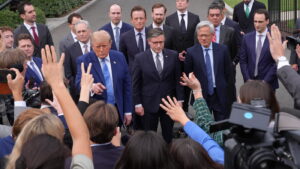
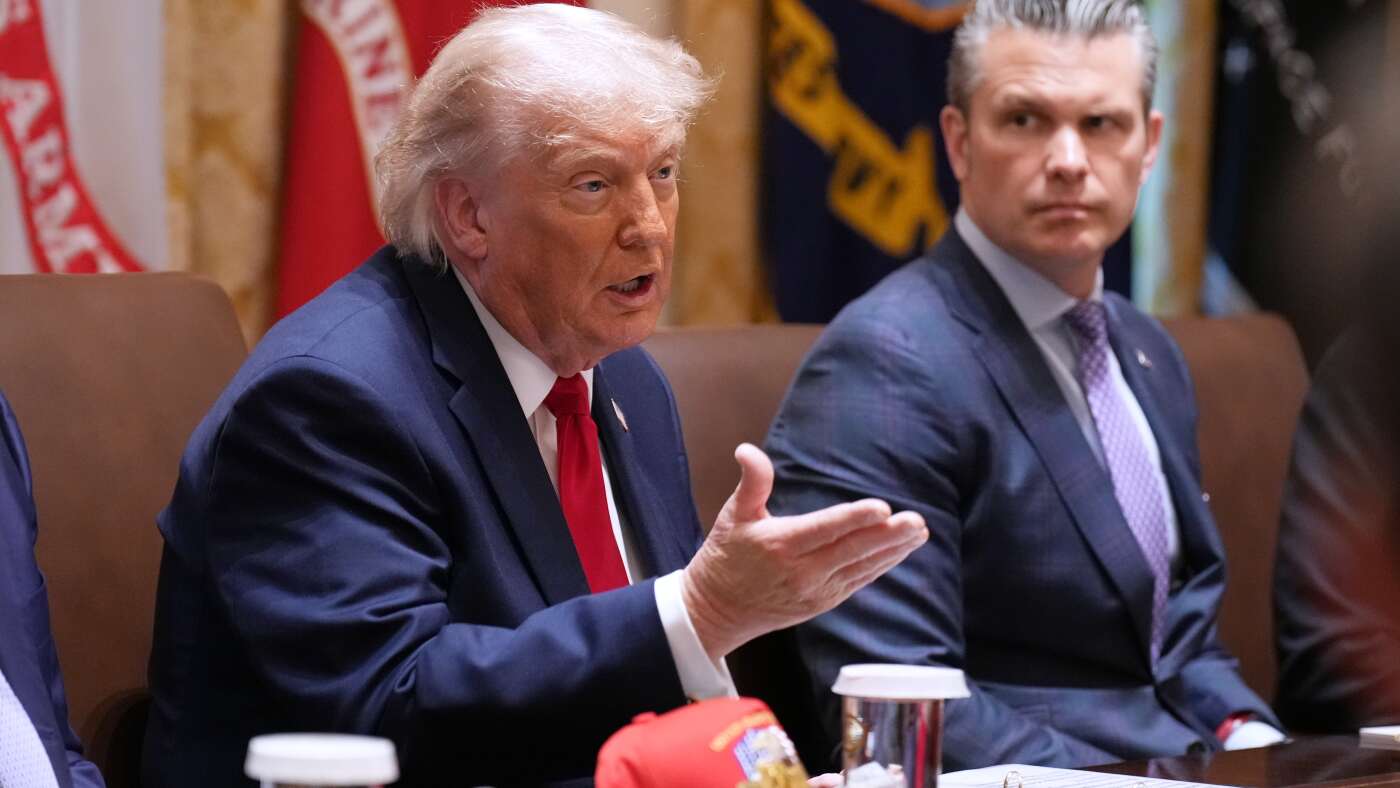
President Donald Trump speaks during a Cabinet meeting at the White House, Wednesday, May 27, 2026, in Washington, as Secretary of Defense Pete Hegseth, looks on. Jacquelyn Martin/AP