
Intensive Ad Spending Marks the 2026 Midterm Election’s Final Stretch
As the 2026 midterm elections approach their climax, substantial ad spending suggests a significant Democratic presence in the House. The central issue isn’t blocking a Democratic surge but gauging its full extent.
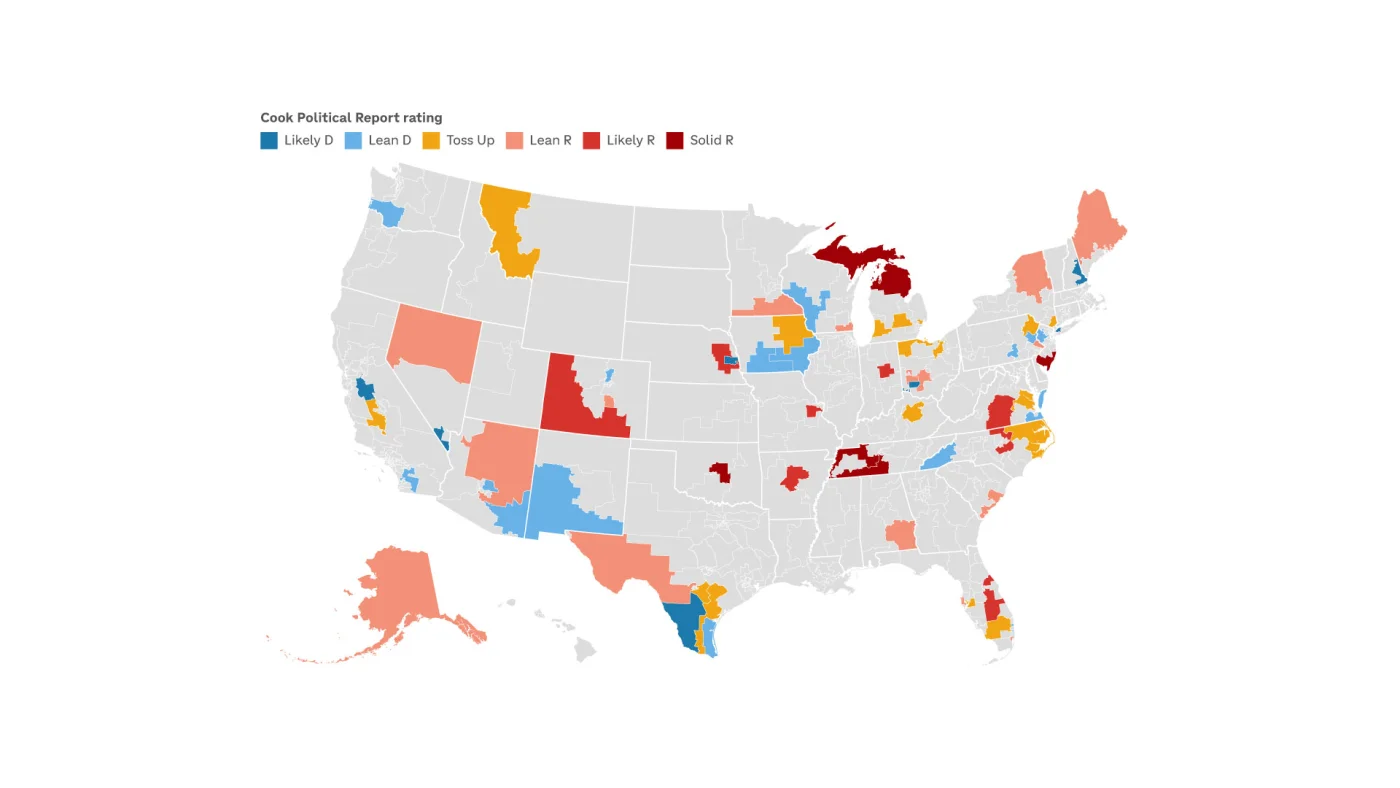
NPR’s investigation highlights an expansive final battleground for the House, encompassing 70 districts with both parties committing at least six figures each for last-minute advertisements.
Prominent spending includes over $10 million in pivotal districts in Michigan, North Carolina, New York, and Florida. Additionally, seven-figure ad campaigns are ongoing in strongly Republican areas within Tennessee, Oklahoma, and Arkansas. Resources are also directed toward districts where Republican gerrymandering might backfire.
In a political climate unfavorable for the ruling party, the Republicans’ slender 218-214 House advantage seems likely to give way to Democratic influence. According to the Cook Political Report, Democrats are predicted to win 220 seats, with 17 races labeled “toss-ups” and another 30 competitive yet leaning Republican.
Key Competitive Districts
Districts with narrow margins in the 2024 presidential election have largely shifted towards Democrats, notably in 10 areas that supported different parties for presidential and House candidates. This includes seats held by Democratic Representatives Adam Gray (CA-13), Nellie Pou (NJ-09), Marie Gluesenkamp-Perez (WA-03), and retiring Republican Don Bacon (NE-02).
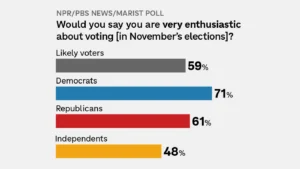
Republicans have notably reduced ad bookings in these areas recently, as indicated by AdImpact data. The latest NPR/PBS News/Marist poll shows Democrats holding a 10-point lead among registered voters and 8 points among likely voters on the generic congressional ballot, indicating a wider field of competitive seats before factoring in candidate quality or external spending.
Economic concerns, particularly cost of living, remain the top priority for voters. Rising gas prices, tariffs, and the ongoing Iran conflict are key economic challenges. Concurrently, a record number of Congressional retirements has been exacerbated by anti-incumbency trends in primaries.
Mid-decade redistricting, following a Supreme Court ruling that further restricted parts of the Voting Rights Act, has altered the political map. Republicans adjusted district lines to increase conservative voter presence in districts held by Democratic Representatives Marcy Kaptur (OH-09), Don Davis (NC-01), Shomari Figures (AL-02), and Darren Soto (FL-09). Similarly, Democrats reshaped districts in California to favor Democratic candidates.
Intensified Spending Across Multiple Districts
As millions head to the polls, both parties are heavily investing in numerous races deemed crucial in determining the elections’ outcomes. Notably, Michigan’s 7th District and North Carolina’s 1st District each have over $12 million in planned spending.
Other significant spends include Florida’s 14th, 22nd, and 25th Districts, New York’s 17th, and Iowa’s 2nd and 3rd Districts. These races favor Democrats or are considered toss-ups. Districts redrawn by Republicans to reduce Democratic voting power, like Alabama’s 2nd and Tennessee’s 9th, and districts that heavily supported Trump in 2024, such as Kentucky’s 6th and Arkansas’ 2nd, are also focal points.
A total of 70 races have six-figure ad spending from each party, with these districts favoring Trump by an average of 9 points in 2024. Notably, 60 districts are priorities for both Democratic and Republican campaign committees, reflecting the Trump administration’s declining voter popularity.
Despite the focus, not every race will be tightly contested or experience a change in party control. Many of the Democratic Congressional Campaign Committee’s targeted “Districts In Play” previously gave Trump nearly 60% of the vote in 2024 and have seen minimal ad spending.
This article was originally written by www.npr.org


Comments are closed.