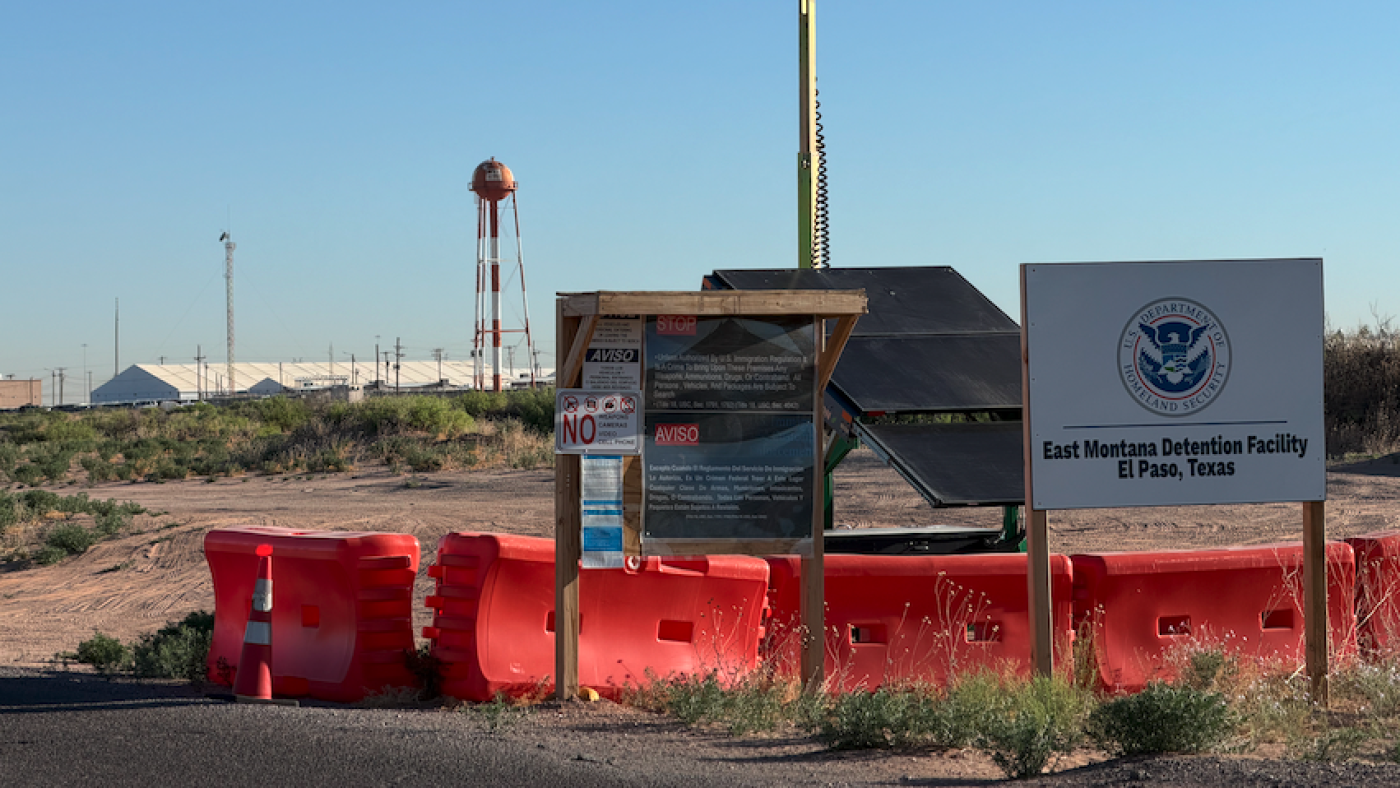

Entrance to Camp East Montana in El Paso, Texas. Sergio Martínez-Beltrán/NPR
Sergio Martínez-Beltrán/NPR
Immigrant deaths in the custody of U.S. Immigration and Customs Enforcement (ICE) have reached record levels, surpassing the previous high set nearly two decades ago. The current fiscal year has already seen 29 deaths, one more than the previous record set in 2004, according to data from government sources.
The most recent case involved Aled Damien Carbonell-Betancourt, a 27-year-old Cuban national who died while detained in Miami, Florida. An initial report from ICE indicated that Carbonell-Betancourt was found unresponsive on April 12, with a “presumed suicide” cited as the cause. However, the exact cause is still under investigation.
ICE records show that Carbonell-Betancourt entered the U.S. in 2024 without proper documentation and was initially released under the parole program, which allows entry for humanitarian reasons without a formal visa. In 2025, he was arrested for resisting an officer and was later transferred to ICE custody earlier this year.
The increase in deaths coincides with a surge in detentions, which have risen by over 70% since President Trump took office compared to the first year under President Biden. The Trump administration has adopted aggressive immigration enforcement tactics, leading to more arrests of undocumented immigrants, including those with and without criminal records, as well as some with temporary protection from deportation.
Currently, around 60,000 individuals are held in ICE detention. The Department of Homeland Security (DHS) attributes the rise in deaths to the increased number of detainees, denying any significant spike in mortality rates. As of April 16, DHS states that “death rates in custody under the Trump administration are 0.009% of the detained population.”
ICE claims to offer detainees access to medical care, with a statement noting, “For many illegal aliens, this is the best healthcare they have received their entire lives.” The statement also encouraged self-deportation, suggesting that “being in detention is a choice,” and promoting the use of the CBP Home App for departure management.
During a congressional hearing, acting ICE Director Todd Lyons attributed the high number of deaths to the unprecedented number of detainees. He stated that the agency spent “almost half a billion dollars last fiscal year … to ensure that people have proper care,” emphasizing that detainees receive medical evaluations within 14 days and are seen by a professional within 24 hours of admission.
Lyons, who announced his resignation shortly after the hearing, stressed, “No death is what we want. We don’t want anyone to die in custody.” When asked about staff numbers in the Office of Detention Oversight, he was unable to provide specific figures.
Concerns were raised regarding delays in public reporting and tracking of detainee deaths. Georgia Democratic Senators Jon Ossoff and Raphael Warnock highlighted that of the 49 reported deaths since January 2025, only 15 were issued a death notice within 48 hours. The senators noted that recent reports lacked detail.
Facilities in Texas and California Report Most Deaths
The Adelanto ICE Processing Center in California and Camp East Montana in El Paso, Texas, have each reported three detainee deaths, the highest numbers within ICE’s extensive detention network. Causes of death, according to ICE’s initial reports, include suicide, alcohol withdrawal, liver failure, and kidney failure. Some detainees exhibited symptoms like shortness of breath.
One death at Camp East Montana was deemed a homicide by the El Paso County Medical Examiner’s Office. Geraldo Lunas Campos initially died from “medical distress,” but the cause was later identified as “asphyxia due to neck and torso compression,” prompting an FBI investigation. According to Chris Benoit, the family’s attorney, Lunas Campos had lived in the U.S. for decades, arriving during the balsero crisis of the mid-1990s.
DHS records show Lunas Campos had criminal convictions, including petty larceny and sexual contact with a child under 11. His children plan to file a wrongful death lawsuit, seeking eyewitness testimony.
Rahul Mukherjee contributed to this report.
This article was originally written by www.npr.org