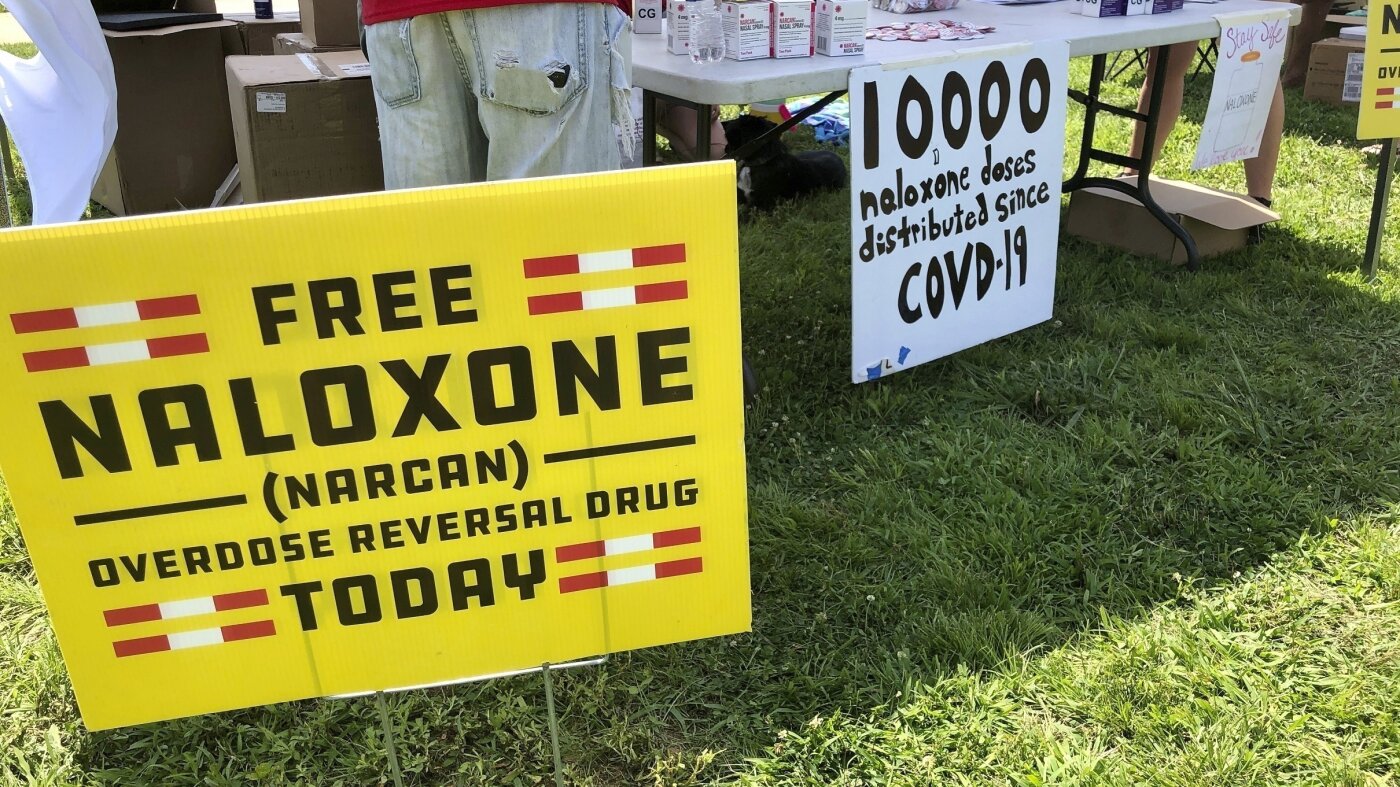

In this 2021 photo, signs are displayed at a tent during a health event in Charleston, W.Va. Public health officials say the spread of naloxone, also known as Narcan, has dramatically reduced overdose deaths in the U.S.
John Raby/AP
hide caption
toggle caption
John Raby/AP
Amidst the ongoing battle against drug overdoses, the U.S. has witnessed a significant decline in fatalities, with a 14% drop recorded in 2025 compared to the previous year. Despite some Western states experiencing an increase in deaths, the overall trend indicates a positive shift.
The latest data from the Centers for Disease Control and Prevention reveals that 69,973 individuals fell victim to drug overdoses last year, which is approximately 11,300 fewer than in 2024. This downward trend is being hailed as a breakthrough by experts.
“This is very good news,” remarked Dr. Nora Volkow, head of the National Institute on Drug Abuse. “We started to see the declines in 2023, but they were small and we weren’t certain they were going to be sustainable.”
Efforts to combat the opioid crisis have been bolstered by increased accessibility to medications that curb cravings and reverse overdoses, such as naloxone, commonly known as Narcan. “Access to naloxone or Narcan has become widespread in communities,” noted Beth Meyerson, a drug policy researcher at the University of Arizona.
Since the decline began in the summer of 2023, several factors have been identified as contributing to the drop in deaths, including a decrease in the potency of illicit fentanyl and a reduction in drug use among young people. Alabama, New York, and Virginia have shown particularly significant decreases in overdose fatalities, with reductions between 25% and 30%.
“I am very pleased that over the past three years, we have seen a decline,” stated New York Gov. Kathy Hochul in a statement, highlighting the halving of opioid deaths from fentanyl, heroin, and illegal painkillers in her state since 2022.
Overall, the number of drug-related fatalities in 2025 marked the lowest level since at least 2019, a stark contrast to the peak of over 112,000 deaths in mid-2023.
Troubling trends remain in some states and communities
Despite these advances, drug overdose deaths in the U.S. remain high compared to global standards. A study from January 2025 highlights Scotland as having significantly lower per capita overdose fatalities than the U.S.
Older populations, as well as predominantly Black and Native American communities, continue to experience high overdose death rates. Emerging synthetic drugs also pose a growing threat on the streets. States like Arizona, New Mexico, and North Dakota have seen an uptick in fatalities in 2025.
Meyerson highlighted the challenges in Arizona, attributing the spike to more potent fentanyl and methamphetamines, along with limited access to healthcare, particularly for rural communities facing long drive times to treatment centers.
Dr. Volkow expressed concern about the widespread use of potent methamphetamines in Arizona and New Mexico, emphasizing the need for improved healthcare access in Native American communities, where overdose mortality rates are double the national average.
This article was originally written by www.npr.org