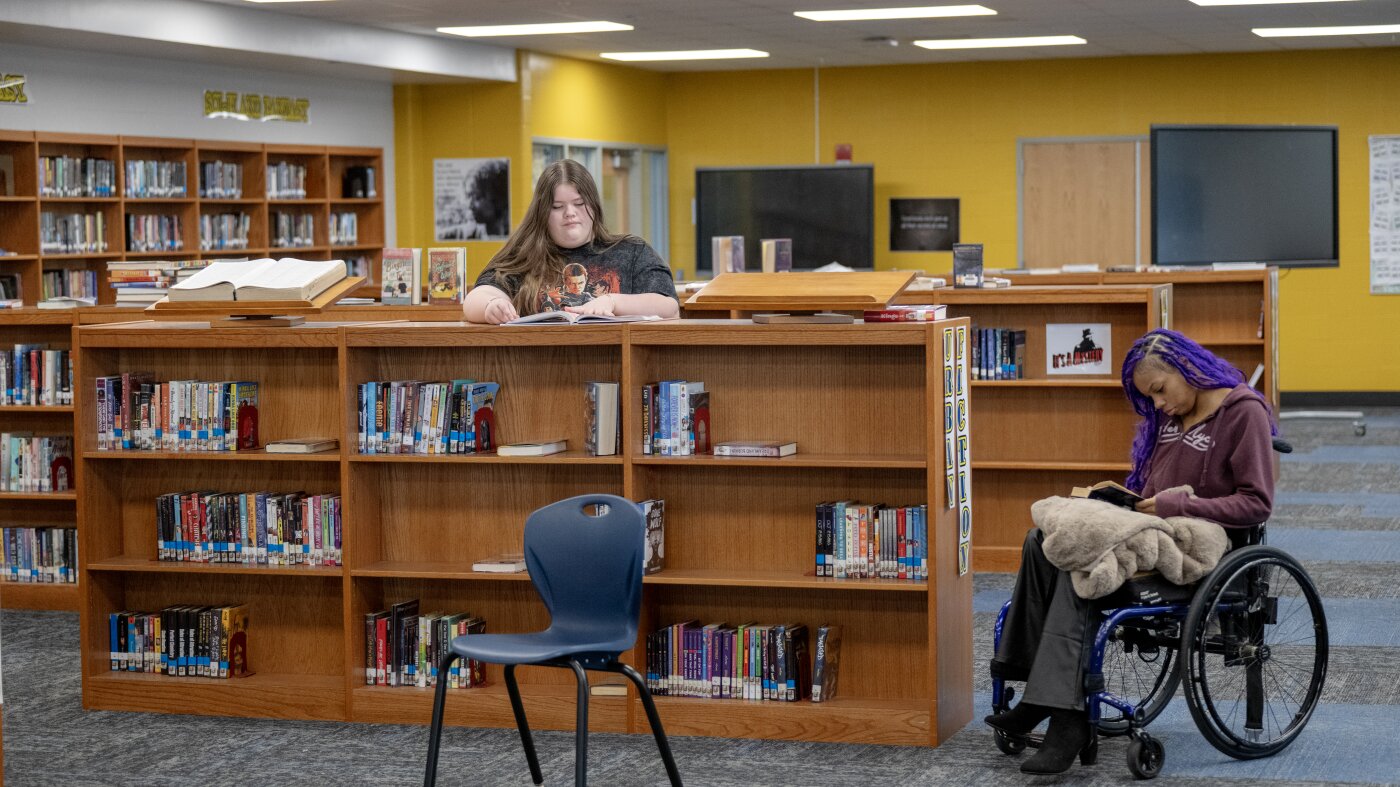

Madelyn Whitt (left) and Quani’e Lanier read in the school library at the Academy @ Shawnee, a magnet middle and high school in Louisville, Kentucky. With cellphones banned at their school, students find other ways to pass time.
Lydia Schweickart for NPR
hide caption
toggle caption
Lydia Schweickart for NPR
How do you encourage teenagers to disconnect from their phones for hours on end? This is the challenge confronting many educational institutions across the United States as over 30 states have now implemented restrictions on cellphone usage during school hours.
Kentucky is among the states enforcing a cellphone-free environment in public school classrooms. Schools within districts have the autonomy to determine how they will enforce this. Some schools collect phones at the beginning of each class, while others permit usage only during lunch breaks.
In Jefferson County, which encompasses Louisville, a “bell-to-bell” policy is in place, mandating that students remain phone-free from arrival until departure at the end of the school day.
To understand the impact of this policy, NPR visited the Academy @ Shawnee, a magnet middle and high school located in Louisville.
Students “know the expectations now”
Prior to the ban, “we didn’t even know the majority of the kids were learning, because they weren’t responding [in class],” says Hollie Smith, now in her second year as the school’s executive principal. “They were just doing things on their phones.”

Hollie Smith, the executive principal of the Academy @ Shawnee, believes the school’s cellphone ban makes students more engaged with their work and each other.
Lydia Schweickart for NPR
hide caption
toggle caption
Lydia Schweickart for NPR
Smith observes noticeable changes across the school: “Kids know the expectations now.”
Interactions have increased, and both teachers and students feel more connected. Even the cafeteria is buzzing with conversations as students shift their attention from screens to each other.
While she sees promising initial results, Smith acknowledges, “I think they absolutely hate it. Their phone is their lives — it’s their world.”
The critical question remains: Are these bans effective?
Feedback from educators and students suggests a consensus — albeit a reluctant one from some students — that the policy is indeed working, though not exactly as intended.
To comply with the new state mandate, Shawnee introduced Yondr pouches, which lock and unlock only with powerful magnets. This approach is being adopted in many schools to support the transition.

The Academy @ Shawnee’s policy states that students must lock their phones in a Yondr pouch at the beginning of each day.
Lydia Schweickart for NPR
hide caption
toggle caption
Lydia Schweickart for NPR
Jefferson County’s phone restriction mirrors strategies recommended by research as the most effective method of managing cellphone use in schools. “At the end of the day,” Smith explains, “we have to do our kids a service. And … they have to be engaged to get the service that we’re providing.”
Finding hacks and work-arounds
Jayden O’Neil, a senior at Shawnee, remains skeptical. “All the students hate it,” she says. “I think they’re gonna rebel more.”
When the ban was introduced in August, each student received a pouch with their name on it. According to O’Neil, students quickly devised methods to circumvent the rule.
“Most kids either brought a spare phone or they said they didn’t have a phone,” she explained. “Or they broke the pouches — they cut them open.”
“People had multiple extra phones,” added Quani’e Lanier, a fellow senior. Some students brought old phones in to distribute to their friends — decoy phones, Lanier says, to put in the pouches.
Both students are nearing graduation and planning their futures. Lanier intends to study nursing in college, while O’Neil has joined the Navy and will commence basic training this summer. They express frustration that the ban undermines their autonomy as young adults.
The policy includes consequences for non-compliance, such as surrendering phones and parental notification. However, Lanier believes these measures are “not enough for people to care.”
“I think we’ve become more productive”
Despite their objections, some students acknowledge that the ban has improved classroom focus.

Jayden O’Neil (left) and Quani’e Lanier in the school library.
Lydia Schweickart for NPR
hide caption
toggle caption
Lydia Schweickart for NPR
“People know they’re going to get in trouble if they keep it out,” says Joseph Jolly, a junior and a student aide in the library.
As students transitioned between classes, some were seen with headphones or phones out, despite the ban. Jolly points out that this behavior is less common in the classroom: “They’ve started to actually focus on work, and I think we’ve become more productive because of that.”

Joseph Jolly, a junior at the school, says that while many students don’t lock their phones in the pouches as they’re supposed to, they’re much less likely to have them out in class.
Lydia Schweickart for NPR
hide caption
toggle caption
Lydia Schweickart for NPR
Jolly admits that while the official policy is often disregarded, students and educators have reached an unspoken agreement to limit phone use during class time.
When asked where his phone was, he confessed, “Truth be told, it’s in my pocket right now,” adding, “But … I’m not doing anything though. That’s the thing!”
A shortage on the library shelves
Anton Caldwell, Shawnee’s librarian for over 20 years, noticed an immediate effect of the ban. More students are visiting the library, and book checkouts have surged:
“I’ve already tripled the number of checkouts that I had for the entire year last year, so far this school year.”

Anton Caldwell, the school librarian, created a plant room in the library.
Lydia Schweickart for NPR
hide caption
toggle caption
Lydia Schweickart for NPR
Although the ban may not result in the complete disconnection from technology that was anticipated, Caldwell notes that it encourages students to unplug. Certain books, especially those by Jenny Han, are in high demand and rarely stay on the shelves.
“The girls are all about Jenny Han right now,” he said, referring to the author of popular teen romances, including To All the Boys I’ve Loved Before and The Summer I Turned Pretty. “I have multiple titles of all of her books, and I think I literally have one in the library right now. Because as soon as it gets checked in, it gets checked back out.”
Principal Smith concludes that while opinions differ on the policy, it unites everyone toward a common goal: “Are there kids that have their phones? Absolutely. But they’re respectful enough to keep them in their pockets or find other things to do.”