USS Gerald Ford’s Record-Breaking Deployment: Challenges and Impact on Families
The USS Gerald R. Ford, an aircraft carrier that set sail from Norfolk, Virginia, on June 24, 2025, has made history with its extended deployment. Initially intended to last a few months, the mission has now stretched over 10 months, making it the longest post-Vietnam War carrier deployment. This journey has taken the ship from Europe to the Caribbean and now to the Middle East, as part of ongoing U.S. military operations.

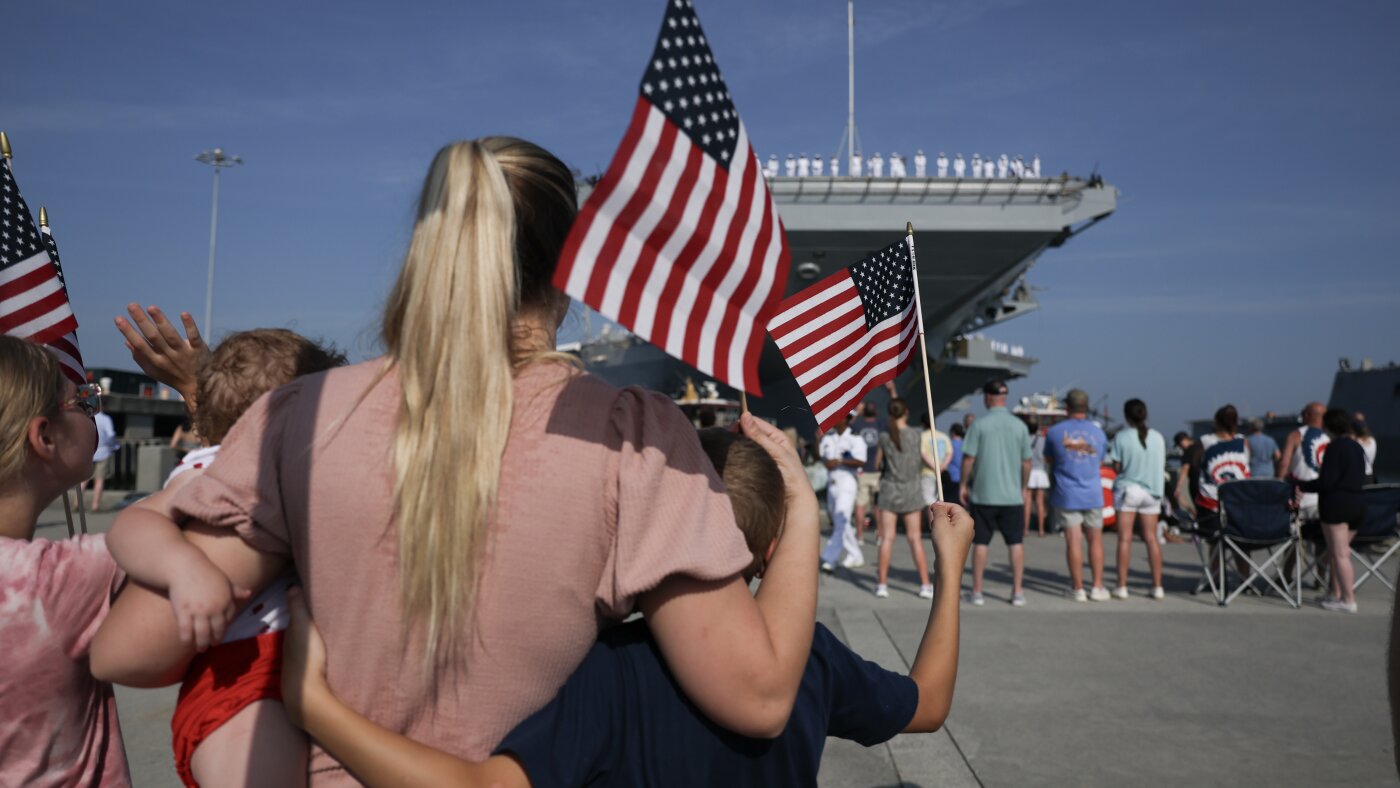
A woman stands with her children as her husband prepares to set sail on the aircraft carrier USS Gerald R. Ford from the Naval Station Norfolk on June 24, 2025, in Norfolk, Va. More than 10 months later the carrier and its crew is still at sea.
Joe Raedle/Getty Images
Despite the significance of this mission, it has not been without its challenges. In March, a fire in the ship’s laundry forced the relocation of 600 sailors, leaving many without personal belongings. “They already have such little stuff out there with them. Imagine losing your underwear, your toothbrush, your toiletries,” shared Taryn Couitt, whose husband is aboard the ship.
Families are doing their best to support their loved ones from afar by sending care packages, although delivery is often delayed. “Because they went from Venezuela to now this war, my package did take about two months to get to him,” Couitt said. “Amazon packages, it’s a hit or miss if they show up, but they are slowly coming in.”

The USS Gerald R. Ford arrives in the Croatian coastal city of Split for a scheduled port visit and maintenance stop on March 28, 2026.
Elvis Barukcic/AFP via Getty Images
Repairs to the ship’s facilities have been ongoing, with the laundry and electrical systems restored after the Croatian port visit. Meanwhile, investigations into the fire’s cause continue with the Naval Criminal Investigative Service and the Bureau of Alcohol, Tobacco, Firearms and Explosives.
Support Systems Back Home
The extended deployment has heightened demands on families back in Norfolk, where support systems are stretched thin. The Armed Services YMCA has reduced its food pantry operations due to increased demand and limited resources, affecting military families, particularly those of junior enlisted sailors.
“We had to do that because when it was first come, first served, some people would sit in their cars literally for six hours,” explained Tessa Davis of the Armed Services YMCA. Food insecurity remains a pressing issue, compounded by financial strains on families as deployments extend beyond the typical six to seven-month period.
Financial and Emotional Strain
Despite receiving hardship duty pay for deployments exceeding 220 days, the compensation has not been adjusted since 2014, offering only minimal relief. “It’s good to get that extra pay, but it’s really not enough,” said Kathy Roth-Douquet, founder of Blue Star Families, which recently launched a chapter in Norfolk to support military families.
Roth-Douquet emphasized the challenges families face, noting, “We’re hearing from families on the Ford that they are struggling. They’re struggling financially because a lot of them can’t keep working and single parenting. We’re hearing that people’s plans were disrupted.”
The USS Ford’s mission continues amidst these challenges, as families and support services strive to adapt to a prolonged deployment that has reshaped their lives.