Archbishop of York Highlights Importance of Faith Representation in Media
Britain’s ability to comprehend global affairs, its history, and the diverse communities within it is at risk, according to the Archbishop of York. He emphasizes the need for accurate religious representation in media to combat this issue.
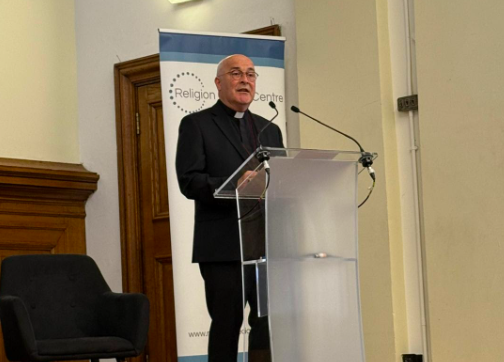
During his keynote speech at the Religion Media Festival, Archbishop Stephen Cottrell advocated for religion to be recognized as a crucial element of public life rather than a niche subject.
Addressing the theme of ‘Protecting the place of religion in the media in a digital age’, he stated that improving religious literacy can help dismantle stereotypes, bolster community unity, and restore trust in public institutions.
“Representation in the media matters because faith matters, because values matter, but also to demystify and familiarise those who have no religious affiliation, so that everyone, of whatever faith or none, can see themselves represented and that faith can be understood, represented and explained,” he explained.
An awareness of religion is vital for interpreting aspects of modern society, from cultural heritage to international conflicts, Cottrell remarked.
He noted that religious literacy allows for engagement from “places of knowledge rather than assumption or prejudice,” thus fostering stronger ties in diverse communities.
Expressing concern about the decline in religious journalism, the Archbishop highlighted the reduction of dedicated religion correspondents and the narrowing scope of faith coverage in the media.
This trend, he argued, leaves the public lacking the information necessary to grasp the religious elements influencing major world events.
Conflicts in the Middle East and Ukraine were cited as examples where understanding religious and historical contexts is crucial.
According to the Archbishop, inadequate media coverage leads to stereotypes and misunderstandings, potentially inciting hostility and reinforcing false narratives online.
He also highlighted a broader crisis of trust in news media, indicating that public confidence has significantly waned over the last decade.
Cottrell stressed that rebuilding trust involves ensuring people feel represented and included, especially in a digital media landscape rife with misinformation and algorithm-driven echo chambers.
The Archbishop underscored the importance of public service broadcasting, arguing it should inform and educate the public about the societal impact of beliefs, values, and traditions.
He asserted that values like honesty, truthfulness, and kindness, deeply rooted in faith traditions, are integral to public life.
“The values are not an ‘add on’ or a ‘take away’ but arise from and are held by the narratives, beliefs and practices which make up the Christian life,” he stated.
Cottrell urged broadcasters to better reflect Britain’s religious diversity and the role of faith in national life, beyond just religious programming.
Reflecting on his recent tour across northern England, he highlighted the need to publicly explain the Christian faith to enhance understanding of Britain’s history, culture, and laws.
He noted that explaining faith is essential not only for believers but for anyone interested in the country’s shared heritage.
The Archbishop praised religious programming that fosters understanding, mentioning the BBC’s recent series on pilgrimage, which brought together individuals from various faiths.
He also pointed to national events like Remembrance services, royal funerals, and coronations, emphasizing the need to explain their religious aspects to contemporary audiences.
Although digital platforms offer faith communities a direct line to the public, Cottrell warned of the risks they pose, including misinformation and polarised debate.
He called for stricter digital space regulations, especially with the rise of artificial intelligence, emphasizing the role of faith in maintaining human dignity and moral accountability.
In his concluding remarks, Archbishop Cottrell questioned whether public service broadcasting offers “values for money” by promoting faith-based values crucial for understanding the world and fostering a kinder society.
This article was originally written by www.christiantoday.com