(Photo: Lambeth Palace/Neil Turner)
A landmark moment in religious history is underway as Archbishop Sarah Mullally, the first woman to serve as Archbishop of Canterbury, prepares for an important journey to the Vatican. This visit underscores a shared dedication to fostering unity between the Anglican and Roman Catholic communities.
Archbishop Mullally was recently installed as the 106th Archbishop of Canterbury. Her ascent to this historic role signifies a new era for the Church of England, as she becomes the spiritual leader of the Anglican Communion.
Planned from April 25 to 28, Archbishop Mullally’s visit to Rome is set to include an audience with Pope Leo XIV at the Vatican. In anticipation of this meeting, the Pope sent a letter during her installation, offering prayers and hoping she would be “guided by the Holy Spirit” and find inspiration in the “example of Mary.”
In her response, Archbishop Mullally expressed gratitude for the Pope’s prayers and reaffirmed her commitment to promoting Christian unity. She emphasized her role in nurturing communion among Anglicans while striving for closer ties with the wider Church.
The Pope’s message was delivered at Canterbury by Cardinal Kurt Koch, head of the Vatican’s Dicastery for Promoting Christian Unity, during the events celebrating her installation.
This exchange took place within a context rich in ecumenical significance. A joint prayer service commemorated the 60th anniversary of the 1966 Common Declaration, a pivotal document that marked a new chapter in Anglican-Roman Catholic relations following a meeting between Archbishop Michael Ramsey and Pope Paul VI.
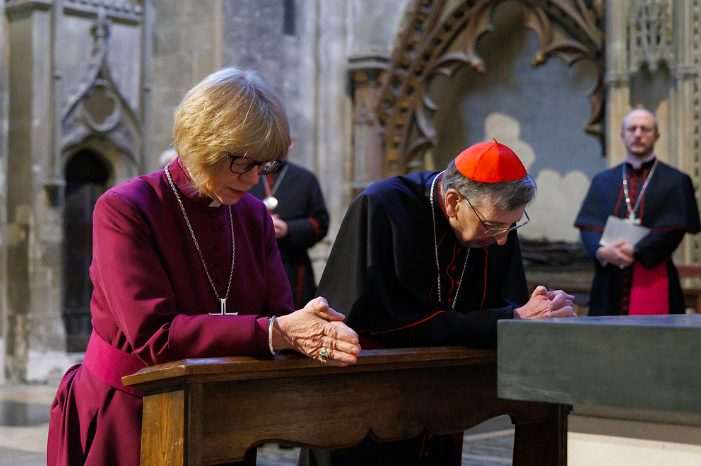
The day after her installation, Archbishop Mullally and Cardinal Koch participated in a prayer service at the site of St Thomas Becket’s martyrdom in Canterbury Cathedral. This act mirrored the historic visit made by Pope John Paul II and Archbishop Robert Runcie in 1982.
Among those present at the prayer service were notable Anglican and Roman Catholic figures, including Archbishop of York Stephen Cottrell, Archbishop Flavio Pace, and Bishop Anthony Ball, the Anglican Centre in Rome’s representative.
Pope Leo echoed sentiments previously expressed by Pope Francis, noting that Christian division should not hinder a united testimony to Christ. He stated that the Gospel is most effectively proclaimed through a “reconciled, fraternal and united” community.
Reflecting on decades of dialogue between the two churches, Archbishop Mullally highlighted the ongoing impact of the meeting between Paul VI and Michael Ramsey. She emphasized the importance of friendship, theological dialogue, and shared witness, acknowledging the roles of ARCIC and IARCCUM in ongoing efforts toward unity.
She remarked, “We pray that the Holy Spirit will continue to guide us into all truth, deepen our fellowship, and lead us ever closer to the visible unity for which Christ prayed.”
Archbishop Mullally’s assumption of her role comes amid challenges for the Church of England and the Anglican Communion. Her installation was attended by around 2,000 guests, including the Prince and Princess of Wales, Prime Minister Sir Keir Starmer, and church leaders from both Britain and the worldwide Church.
In her sermon, Archbishop Mullally emphasized the theme of Jesus as the Good Shepherd, expressing hope rooted in the incarnation and God’s enduring presence with His people. She also addressed the church’s past failings in safeguarding, calling for truth, compassion, justice, and action.
While welcomed by many as a seasoned and unifying leader, Archbishop Mullally steps into her new role at a time of tension within the Anglican Communion, with some conservative factions questioning her authority.
This article was originally written by www.christiantoday.com