
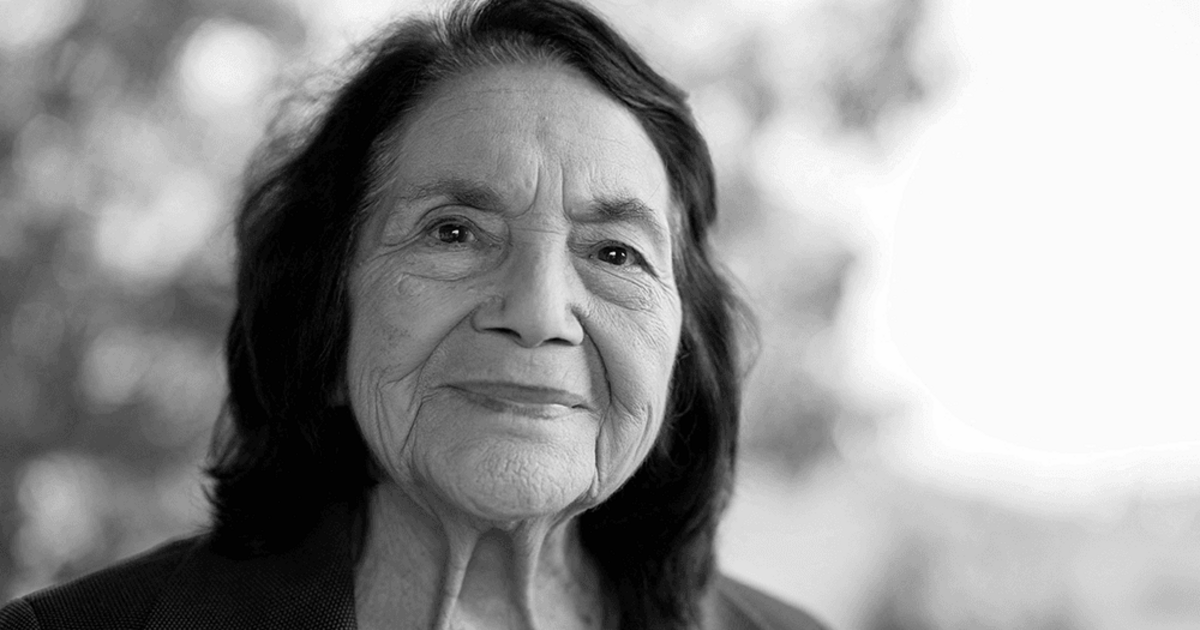
The passing of Dolores Huerta, a pivotal figure in American labor history, marks the end of an era for farmworkers’ rights. Huerta, who passed away at the age of 96, was instrumental in co-founding the United Farm Workers (UFW) alongside Cesar Chavez, and her efforts greatly improved conditions for agricultural laborers across the United States.
During the 1960s and ’70s, Huerta emerged as a leading force in the UFW, taking on roles such as chief negotiator, strike organizer, and lobbyist. Her work helped secure crucial benefits for farmworkers, including job security, healthcare, retirement plans, and protections like rest breaks, clean water, and safe working environments.
Huerta is credited with creating the UFW’s rallying cry “Si, se puede,” later popularized by Barack Obama’s 2008 presidential campaign as “Yes, we can.” Even into her 90s, Huerta was active in advocating against policies like those of President Donald Trump, while also supporting political candidates and voter registration efforts nationwide.
Cesar Chavez, who passed away in 1993, often served as the public face of the UFW, known for his nonviolent activism inspired by figures like Gandhi and Martin Luther King Jr. However, Huerta’s relationship with Chavez was complicated by her later accusations of sexual assault against him, which surfaced in 2026.
Huerta’s Pivotal Role
While Chavez garnered much of the public attention, Huerta was deeply engaged in negotiations and legislative lobbying. Her activism was not without personal risk; she was arrested numerous times and suffered injuries during a 1988 protest. Despite this, she chose to focus on tangible change over fame, as she explained in a 2012 PBS interview: “He said, ‘One of us is going to have to be the spokesperson. Are you all right if I’m the spokesperson?’ Of course, I said yes.”
Early Life and Activism
Born in Dawson, New Mexico, Huerta was raised in Stockton, California, where her mother instilled in her a strong sense of social justice. Initially a schoolteacher, Huerta was moved by the poverty she witnessed and turned to activism, founding the Agricultural Workers Association before partnering with Chavez to establish the National Farm Workers Association in 1962.
The UFW launched a series of strikes and boycotts in the mid-1960s, targeting California’s grape and lettuce growers, which gained support from figures like Martin Luther King Jr. and Robert F. Kennedy. The movement faced resistance, notably from Governor Ronald Reagan, who publicly opposed the UFW’s actions.
Legislative Achievements
The UFW’s efforts led to significant victories, including the historic California Agricultural Labor Relations Act of 1975, granting collective bargaining rights to farmworkers. Huerta’s unique position as a woman in negotiations often gave her an advantage, as she noted in a PBS interview: “They really didn’t know how to respond because they couldn’t do the usual forceful type of thing.”
In recognition of her contributions, Huerta received the Presidential Medal of Freedom in 2012. Her life and achievements were also celebrated in the documentary film “Dolores,” showcased at the Sundance Film Festival in 2017.
Even as the UFW’s influence waned, Huerta’s dedication to activism continued. She founded the Dolores Huerta Foundation in 2002 to promote community involvement and advocate for issues such as immigration reform and women’s rights. Huerta’s legacy lives on through her children, including those she had with Chavez, and her continued impact on the fight for social justice.
This article was originally written by sojo.net


Comments are closed.