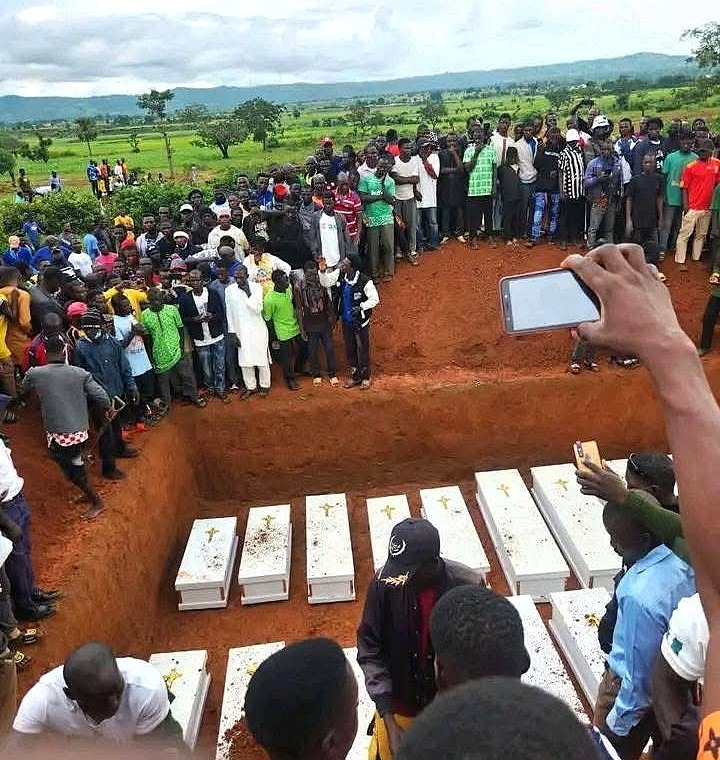
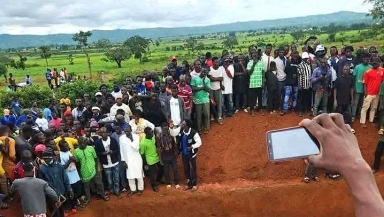
(Photo: Catholic Diocese of Kafanchan)
A somber atmosphere enveloped Kaduna state, Nigeria, as communities came together to mourn the loss of 27 Christians mercilessly killed in an attack attributed to suspected Fulani terrorists. The Catholic funeral service, attended by numerous church leaders and congregants, highlighted the communal grief and unity against such violence.
The victims, including three evangelical Christians, were brutally attacked in Naridon village, Kauru County, just before midnight on July 26. A separate funeral for these three individuals took place earlier in the week.
The Rev. Abai Peter, representing the Catholic Diocese of Kafanchan, shared with Christian Daily International-Morning Star News, “Twenty-seven victims of a deadly attack were laid to rest following a solemn funeral Mass attended by thousands of mourners. Pastors and members from other Christian denominations also joined in the funeral as a show of unity and solidarity with the bereaved families and the entire community.”
The service was overseen by the Catholic Bishop of Kafanchan Diocese, the Rev. Julius Yakubu Kundi, along with numerous other regional priests, according to Peter.
“The attackers invaded the village around midnight, unleashing violence that lasted for nearly two hours,” explained Peter. “Homes were attacked, innocent residents were killed, and many others sustained injuries while several families were displaced. As the coffins were lowered into their final resting place, the village was overwhelmed by sorrow. Men, women, and children wept openly, mourning loved ones whose lives were cut short in the tragic assault. The painful cries of grieving relatives echoed across the burial ground, reflecting the deep wounds inflicted on the community.”
Open Doors, a Christian support organization, reported that among the victims were 10 women and 11 children, one of whom was merely three years old.
A Call for Action and Faith
During his homily, Rev. Kundi emphasized the criminal nature of the attack, urging the government to enhance their preventative measures. “It is not a boundary conflict but an act of criminality that government must work harder to prevent because this only happens in a country where there is no respect for the rule of law,” he asserted.
Kundi encouraged the grieving to maintain their faith in God and reject despair or hatred. “God sees everything,” Kundi said. “He knows the pain of His people, and He will reward everyone according to their deeds. No act of evil escapes His judgment, and no sacrifice made in faith is forgotten before Him.”
Peter added that Kundi reassured families of the hope in resurrection, asserting that death is not the end for believers in Christ. He called for ongoing prayers for peace in southern Kaduna and other affected areas.
“People of goodwill from various denominations who attended the funeral offered prayers for the repose of the deceased and for God’s consolation upon the grieving families,” Peter stated. “They also called on government and security agencies to intensify efforts to protect vulnerable communities from recurring attacks.”
Local resident Barnabas Musa identified 28 of the Christians who perished in the attack, listing names such as Geoffrey Monday, Maria Pius, and Ladi Monday among others. Those injured included Comfort Monday, Success Monday, and James Emmanuel.
Violence in Context
According to Open Doors’ 2026 World Watch List, Nigeria remains the most perilous country for Christians, with 3,490 of the 4,849 Christians killed worldwide for their faith between October 2024 and September 2025 being Nigerians. The country ranks seventh on the list of 50 nations where Christian life is most challenging.
The UK’s All-Party Parliamentary Group for International Freedom or Belief (APPG) highlighted in a 2020 report that while most Fulani do not espouse extremism, some have adopted radical Islamist ideologies. “They adopt a comparable strategy to Boko Haram and ISWAP and demonstrate a clear intent to target Christians and potent symbols of Christian identity,” the report states.
Christian leaders suggest that attacks by herdsmen aim to seize land and impose Islam due to arid conditions hindering their traditional livelihoods. The Middle Belt of Nigeria, particularly its North-Central zone, witnesses frequent assaults on farming communities by Islamic extremist Fulani militia, with numerous fatalities, predominantly among Christians.
Further complicating the security landscape, groups like Boko Haram and ISWAP are active in the northern states, inflicting violence including raids, sexual assaults, and abductions. A new jihadist group, Lakurawa, has emerged in the northwest with ties to Al-Qaeda, further heightening concerns as it wields advanced weaponry and a radical agenda.
© 2026 Christian Daily International-Morning Star News
This article was originally written by www.christiantoday.com