An Anonymous Trader Profits from Biden’s Last-Minute Pardons
In a surprising turn of events, an unidentified trader has reportedly made a windfall of over $300,000 by accurately predicting pardons issued by former President Biden during his final hours in office. This remarkable feat was revealed through data shared exclusively with NPR by Bubblemaps, a cryptocurrency analytics firm.
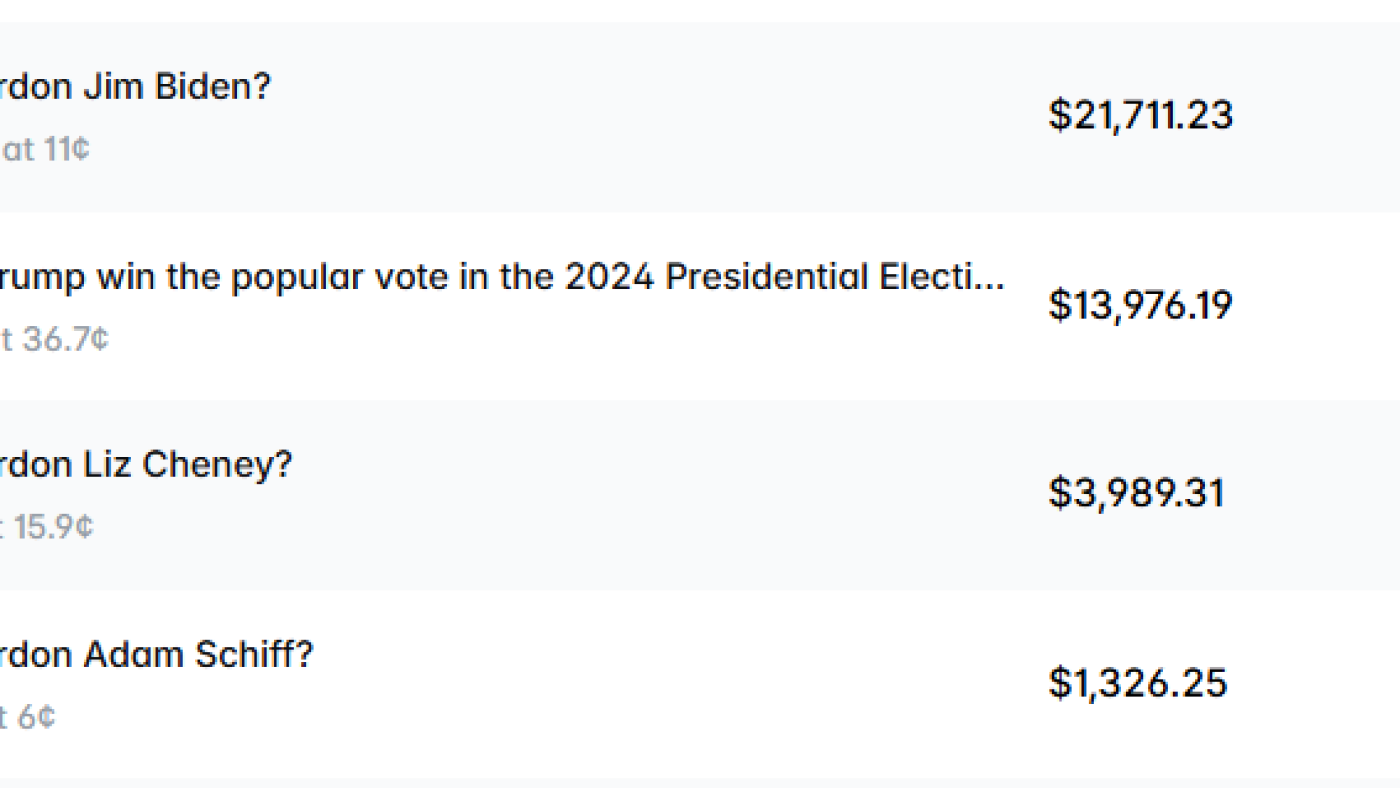
As Biden granted pardons shortly before his departure from the White House, the trader placed significant bets on four specific names. The chances of these individuals receiving pardons plummeted to near zero on the prediction market site Polymarket.
The trader’s identity remains a mystery, but they wagered approximately $64,000 on the prospect of pre-emptive pardons for Jim Biden, Liz Cheney, Adam Schiff, and Adam Kinzinger. Although none of these individuals faced criminal charges, they were pardoned to protect against potential future prosecutions during Trump’s subsequent term.
Just a month earlier, the same individual placed a strategic bet that Biden’s son, Hunter, would be pardoned over gun and tax charges. The combined profits from these five bets amounted to $316,346, according to Bubblemaps’ analysis.
Columbia Law School’s Joshua Mitts commented on the improbability of such precise predictions happening by random chance, saying, “The odds of this happening by random chance are virtually zero.” Mitts speculated on the possibility of the trader being a White House insider or possessing insider information without being directly involved.
Polymarket did not respond to requests for comment regarding these suspicious trades.
Investigating Crypto Transactions Behind the Trades
Bubblemaps’ forensic team employed pattern-matching AI software to delve into the suspicious trades linked to Biden’s pardons. They uncovered two accounts with a flawless record of betting on these pardons.
Nick Vaiman, founder of Bubblemaps, explained, “We looked at all the accounts trading on this one market and found a connection between two accounts, which was a shared deposit wallet.”
This discovery indicated that both accounts transferred profits from Polymarket bets to the same cryptocurrency wallet on Kraken, a U.S.-based crypto exchange. However, exchanges like Kraken do not readily disclose information about individual accounts, making it challenging to identify the trader.
Kraken’s “know-your-customer” rules require identity verification, but identifying a customer based solely on a crypto wallet remains difficult. Mitts noted that federal prosecutors often find that crypto wallet-holders engaging in insider trading do so through intermediaries or shell companies.
Prediction Markets Flourish Amid Controversy
During Trump’s second term, prediction markets like Polymarket and Kalshi gained traction, despite concerns about potential abuse and manipulation. The administration embraced an industry once shunned in Washington.
Bernstein, an investment firm, projects that prediction markets could become a $1 trillion industry within the next four years. Donald Trump Jr., the president’s son, serves as an advisor to both Kalshi and Polymarket.
The sector has faced controversy over suspected insider trading. Notable instances include a Polymarket trader’s $400,000 profit shortly before Venezuelan leader Nicolás Maduro’s ousting and an account named “Magamyman” earning over $500,000 after betting on Iran’s Ayatollah Ali Khamenei’s demise following an Israeli strike.
Despite these controversies, U.S. prosecutors have not commenced investigations or filed charges related to potential insider trading.
The largest U.S. prediction market, Kalshi, is regulated by the Commodity Futures Trading Commission (CFTC), which prohibits betting on markets related to war, assassinations, and terrorism. However, the CFTC has maintained a limited oversight approach compared to the Biden administration, which restricted most “event contracts” except those with public value, like weather and grain prices.
While the Trump administration has taken a more hands-off approach to controversial Polymarket markets, the Biden administration’s FBI raided Polymarket’s CEO’s home, forcing the site to wind down in the U.S. Polymarket continues to operate primarily overseas, accessible to Americans via virtual private networks.
Nizan Packin, a law professor at Baruch College, expressed concerns about the lack of regulation in these markets, emphasizing the need for proper guardrails and consequences to mitigate potential risks.