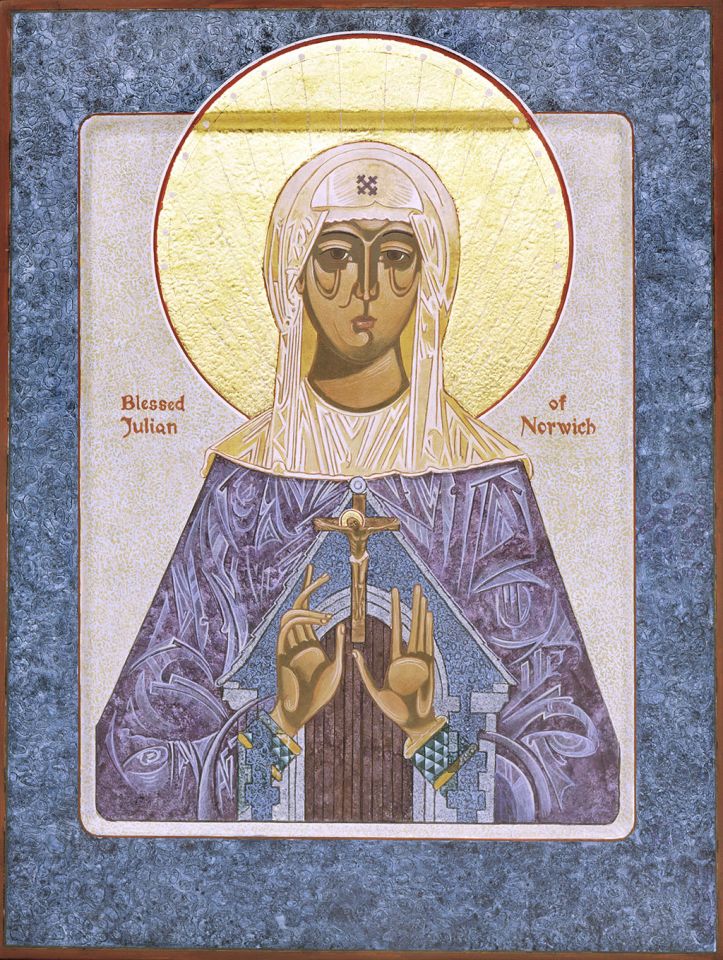
Julian of Norwich holds a unique place in history, remembered each year on 8 May. Her book remains a cornerstone of Christian spirituality and is known as the first book in English penned by a woman. Here’s an exploration of her profound journey.
Anchorites: A Life of Solitude
Anchorites, derived from the Greek word άναχωρητής (anachoretes), were individuals who chose a life of seclusion, bound to a single location. These hermits, living in cells called anchorholds attached to churches, devoted themselves entirely to prayer. Female anchorites, or anchoresses, were more prevalent during this period. They lived in isolation but maintained connections through windows for communication and sustenance.
The Anchorite’s Cell
Typically, anchorite cells were small, one or two-room structures built against church walls. A window opened to the outside allowed for the passage of food and waste, while another window connected them to the church, facilitating communion. Some anchorites were confined, while others could roam the church grounds or had access to a garden. They were often seen as holy figures, receiving visitors seeking their wisdom.
The Life of Mother Julian
Mother Julian, an anchoress in Norwich, was born around 1342. Surviving the Black Death that struck her city when she was just six, her life as an anchoress may have been influenced by this experience. Norwich, a bustling city in medieval England, was the second-largest after London, with a rich religious life marked by numerous churches and religious figures.
Understanding the Name Julian
Though Julian is considered a male name today, it was used for both genders during the medieval period. Mother Julian may have been named after St Julian’s Church in Norwich, where she resided. The church, not named after her, was likely dedicated to an earlier saint, possibly St Julian of Le Mans, St Julian the Hospitaller, or St Juliana of Nicomedia.
St Julian’s Church: A Historical Site
St Julian’s Church, rebuilt after Viking destruction, was associated with the Benedictine priory at Carrow Abbey in Norwich. Mother Julian’s cell was located in the churchyard, and she likely belonged to this priory. Despite her seclusion, she often received visitors, supported by her faith and perhaps accompanied by a cat.
Revelations and Writings
In 1373, at the age of thirty, Mother Julian experienced a series of visions during a severe illness. These ‘shewings’ provided deep insights into Christian doctrines, focusing on Christ’s crucifixion and divine love. She shared these visions with visitors and later expanded them into theological reflections, becoming the first known female author of an English book.
The Content of the Visions
Mother Julian’s visions explored themes of suffering, sin, and divine love. Her famous phrase, “All shall be well,” emerged from a revelation about the necessity of sin for good. Her visions also offered insights into Christian commandments, creation, prayer, and the Trinity, painting a picture of hope and divine love.
The Maternal Imagery of God
Ahead of her time, Mother Julian described God with maternal characteristics, emphasizing a nurturing bond similar to a mother and child. Her writings added a compassionate dimension to traditional views of God, complementing paternal imagery with maternal compassion, and are seen as early feminist theology.
Legacy and Influence
Mother Julian’s death is estimated to have occurred between 1416 and 1430. Her cell continued to be used until the Reformation. Her writings, largely unknown until 1670, were published by Hugh Paulinus de Cressy. This sparked renewed interest, leading to further editions and translations, especially after a modern edition was published in 1901.
St Julian’s Church and Modern Memorials
St Julian’s Church, restored after damage during the Blitz, now features a reconstructed anchorite cell and a stained-glass window depicting Mother Julian. Nearby, the Julian Centre and other memorials celebrate her legacy. She is commemorated by Anglicans on 8 May and recognized across Christian denominations for her mysticism and insights into feminist theology.
Revival of Interest
The COVID lockdown sparked renewed interest in Mother Julian, with her story resonating with those in isolation. Events in 2023 marked the 650th anniversary of her revelations, and she was featured on BBC Radio 4’s Something Understood.
Anglican Collect Prayer
The Anglican collect prayer for Julian is as follows:
“Most holy God, the ground of our beseeching,
who through your servant Julian
revealed the wonders of your love:
grant that, as we are created in your nature and restored by your grace,
our wills may be made one with yours,
that we may come to see you face to face
and gaze on you for ever;
through Jesus Christ your Son our Lord,
who is alive and reigns with you,
in the unity of the Holy Spirit,
one God, now and for ever.”
This article was originally written by www.christiantoday.com