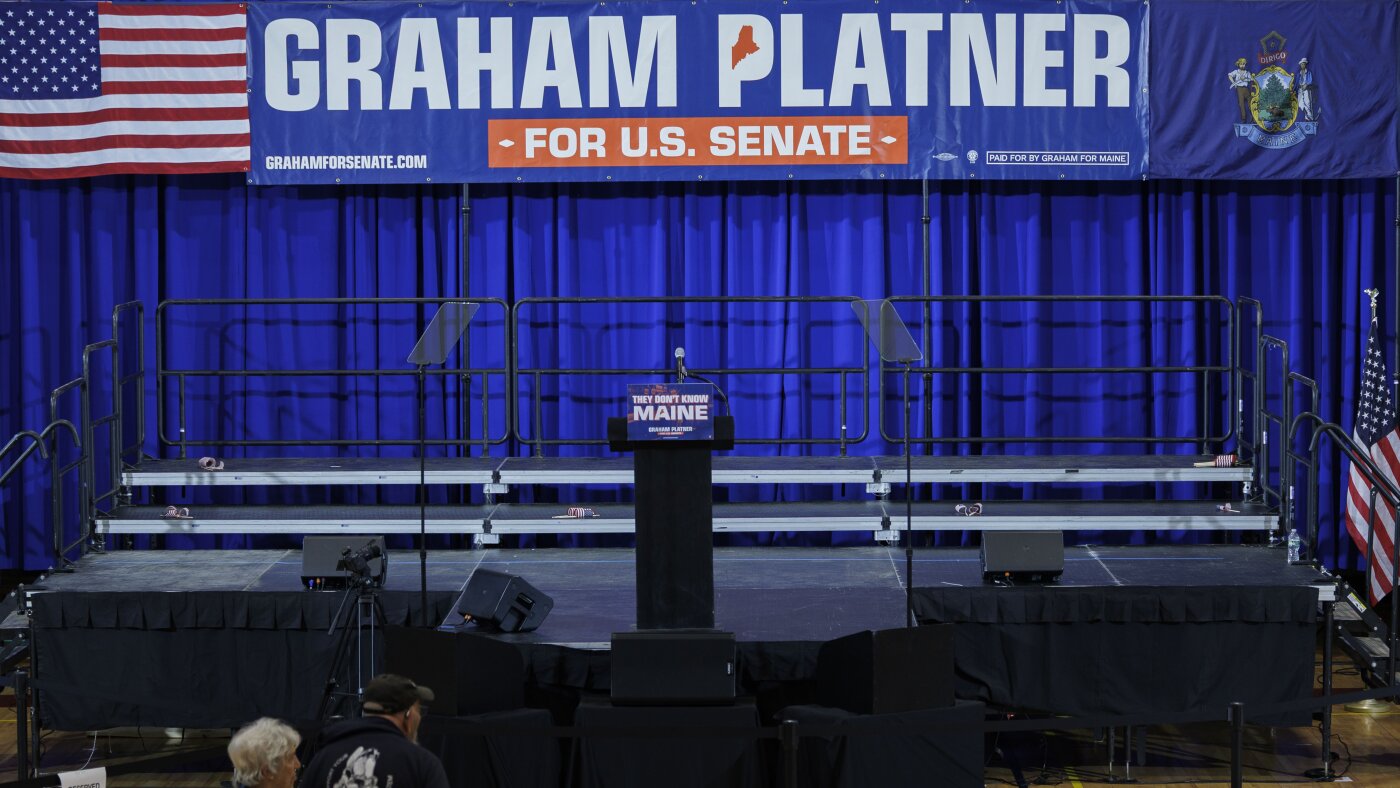

An empty stage is seen at a Graham Platner campaign event on June 9, 2026 in Blue Hill, Maine.
CJ Gunther/Getty Images
hide caption
toggle caption
CJ Gunther/Getty Images
In a sudden twist in Maine’s political arena, the Senate campaign of Graham Platner has been halted amid serious allegations. These developments have led to a cascade of withdrawals of support from his Democratic allies.
The announcement came from Platner himself through a social media video on Wednesday, stating, “We believe that for the movement to continue, it can’t be me. And for that reason, we are suspending campaign operations.”
Platner expressed concerns about the perception of his decision, noting, “This is incredibly difficult because I know that some will think it’s an admission of guilt, and it most certainly is not. We’re not doing it because of the allegations. We’re doing it because of the structures that are being taken away from us by those in power.”
Despite previous controversies, including a controversial tattoo and offensive online posts, Platner’s campaign endured until a Politico report surfaced, detailing a rape allegation by Jenny Racicot, a former acquaintance. Platner denied these accusations, asserting, “Any accusation of non-consensual behavior is categorically untrue.”
Before the Politico revelation, Racicot was also featured in a New York Times article, where she, along with others, described Platner’s past behavior as “unsettling.” However, she did not disclose the rape allegation until later, detailing her account to CNN.
Following the Politico article, Platner hinted at reevaluating his campaign, stating in a social media video that he was reflecting on the future of his campaign and his goals in Maine.
As pressure mounted, several Democratic figures, including Rep. Ro Khanna, Sen. Ruben Gallego, and Sen. Elizabeth Warren, withdrew their endorsements. Vermont Sen. Bernie Sanders also rescinded his support, as did The Maine Democratic Party, which urged Platner to exit the race.
The decisive blow came when the Senate Democrats’ campaign arm declared it would not invest in Platner’s campaign if he remained a candidate.
Platner was given until July 13 to withdraw under state election rules, allowing the Democratic Party time to nominate a new candidate before the July 27 deadline.
What happens now?
Initially, Platner was seen as a key contender against GOP Sen. Susan Collins, with hopes that his campaign could pave the way for anti-establishment ideas. Now, Democrats are in a rush to regroup and strategize their next steps.
The Democrats’ path to reclaiming the Senate heavily relies on winning in Maine, a state President Trump lost in 2024. However, the loss of Maine in the upcoming elections would significantly narrow their chances, as highlighted by Jessica Taylor from the Cook Political Report.
The Maine Democratic Party recently convened over 100 members to discuss the possibility of holding a nominating convention should a vacancy arise. They noted in a statement their intention to mobilize around a new nominee to challenge Collins in November.

Graham Platner speaks on June 9, 2026 in Blue Hill, Maine.
CJ Gunther/Getty Images
hide caption
toggle caption
CJ Gunther/Getty Images
As the search for a new candidate begins, several names have emerged as potential contenders for the Democratic nomination, including Maine Secretary of State Shenna Bellows, former Maine CDC head Nirav Shah, and former state Senate President Troy Jackson.
An exploratory committee has already taken steps by submitting paperwork to the Federal Election Commission on behalf of Jackson. While his background appeals to working-class voters, his ties to Platner may pose an issue.
Shah has indicated he is “evaluating” a potential run, suggesting that candidates should participate in televised debates and public town halls. His connection with Maine residents could be advantageous, although his recent voting history in Georgia might be a setback.
Meanwhile, Bellows, who previously lost to Collins by a wide margin in 2014, may also consider entering the race. Another possible candidate is Dan Kleban, owner of Maine Beer Company, who had a short-lived campaign for Senate last year.
According to Taylor, “Virtually any Democrat that does not have as substantial baggage as Platner represents a much better chance against Susan Collins.” Starting late in the race, Democrats aim to refocus the campaign on Collins, which could prove pivotal.