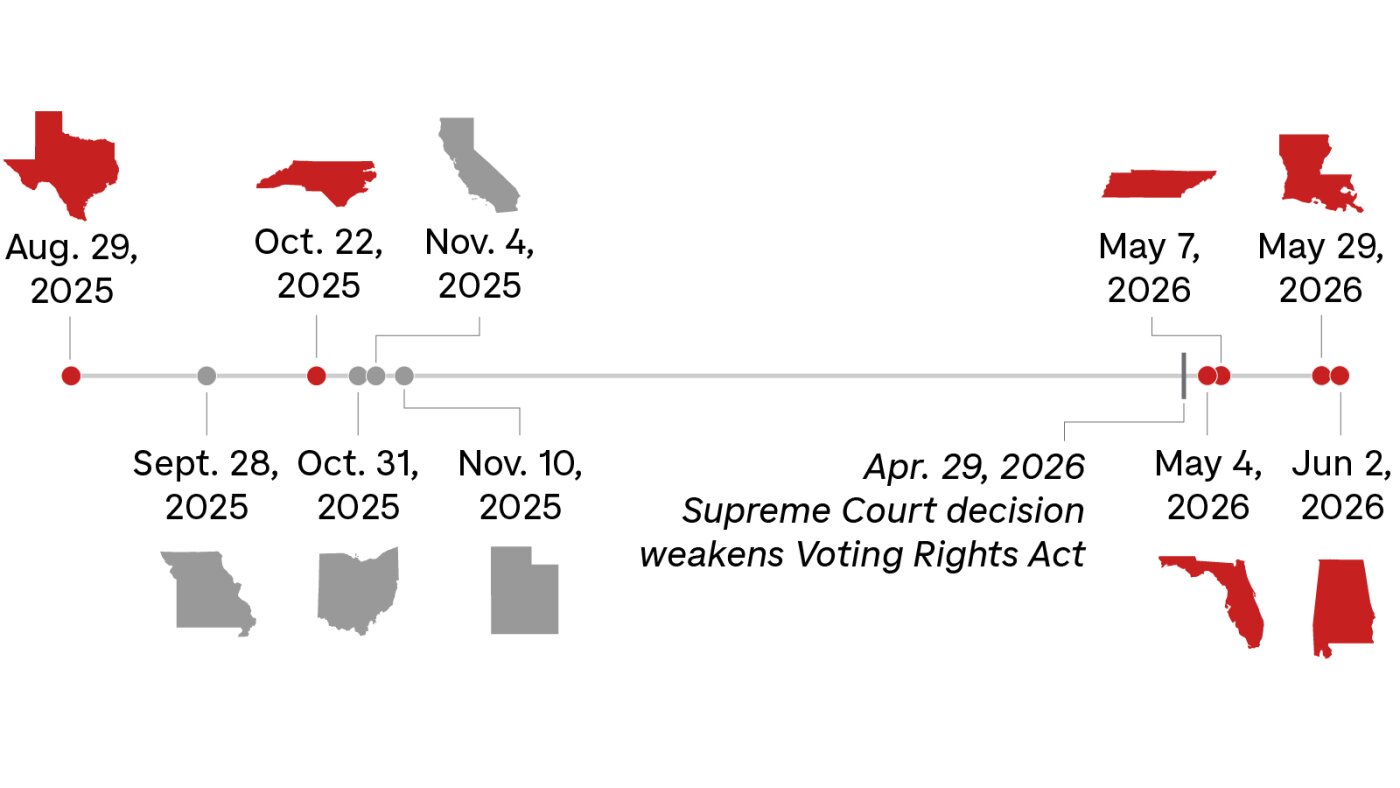
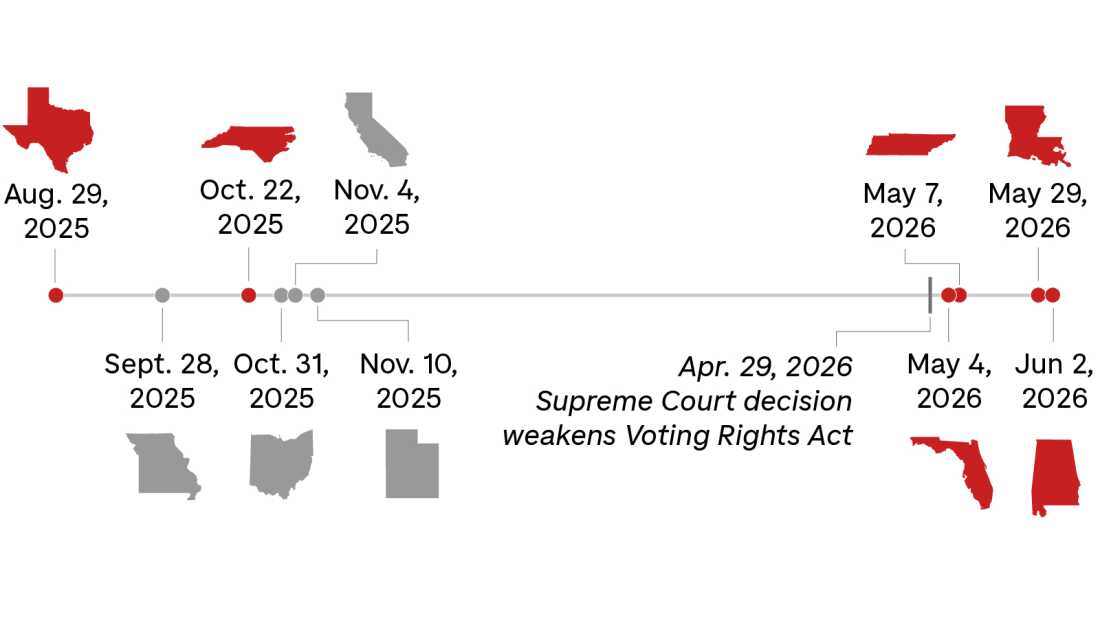
When new congressional maps were enacted for each state, according to Ballotpedia
Rahul Mukherjee/NPR
hide caption
toggle caption
Rahul Mukherjee/NPR
Mid-decade redistricting has been a prominent political issue, fueled by former President Trump’s initiative and a recent Supreme Court ruling that has altered the landscape of electoral districts. This verdict, which has weakened the Voting Rights Act, has particularly influenced states with significant Black populations.
In several GOP-controlled states, including Texas, Florida, and Louisiana, districts have been redrawn in ways that reshape majority-Black or plurality-Black areas, often integrating them with predominantly white regions. This shift is notable given the historical tendency of Black voters in these areas to support the Democratic Party, with a reported 78% backing Kamala Harris in the 2024 election.
Republicans assert that these changes aim to enhance their electoral prospects. Here’s an overview of the impact in specific states:
Texas
Texas was among the first to respond to Trump’s call, adopting a map that bolsters Republican representation by five seats. This restructuring has diminished Black representation in the Houston area. Most notably, the 9th Congressional District was reshaped into the 18th, encompassing areas like Sunnyside and Missouri City, which had previously shown strong support for Harris.
This new alignment resulted in a primary runoff between two Black Democratic incumbents, with Rep. Al Green losing to Rep. Christian Menefee for the newly defined 18th District.
Voting Rights Act Ruling
In a pivotal ruling, the Supreme Court declared Louisiana’s congressional map unconstitutional, citing racial gerrymandering. This decision has weakened the Voting Rights Act’s safeguard against racial bias in districting and has led to the alteration of Black-majority districts in several states.
Florida
In line with the Supreme Court’s decision, Florida Republicans revised districts to potentially secure additional seats in Congress. The 20th District, previously the state’s largest Black-majority district, was reconfigured, reducing its Black population from nearly 53% to 45%. This change affected areas like Belle Glade and Riviera Beach, which were moved to districts with a smaller Black demographic.
Louisiana
Louisiana’s new configuration removes one of its two Black-majority districts. Shreveport, a city with a strong Democratic preference, is now part of a district leaning Republican, while Baton Rouge’s Black neighborhoods are divided between the 2nd and 6th Districts.
Alabama
After an earlier court ruling was overturned, Alabama’s redistricting plan eliminating one of its Black-majority districts is now in effect. The new map separates cities like Mobile and Montgomery into different districts with less Black electoral influence, aligning them with Republican-leaning areas.
Tennessee
Tennessee legislators have dismantled the state’s sole Black-majority district, with Memphis now divided among three districts, significantly reducing its Black representation.
North Carolina
In North Carolina, redistricting in 2025 has altered the 1st District, previously the state’s most Black-populated district, by merging it with predominantly Republican counties, reducing its Black demographic to 34%.
Methodology
This analysis uses data from the 2020 Census. Historical and current district boundaries were sourced from the Census Bureau and state government websites, respectively.
Maps utilize a dot system, each representing 250 people, color-coded by racial identification. The analysis considers both single-race Black respondents and those identifying as Black with another race, per Voting Rights Act requirements.