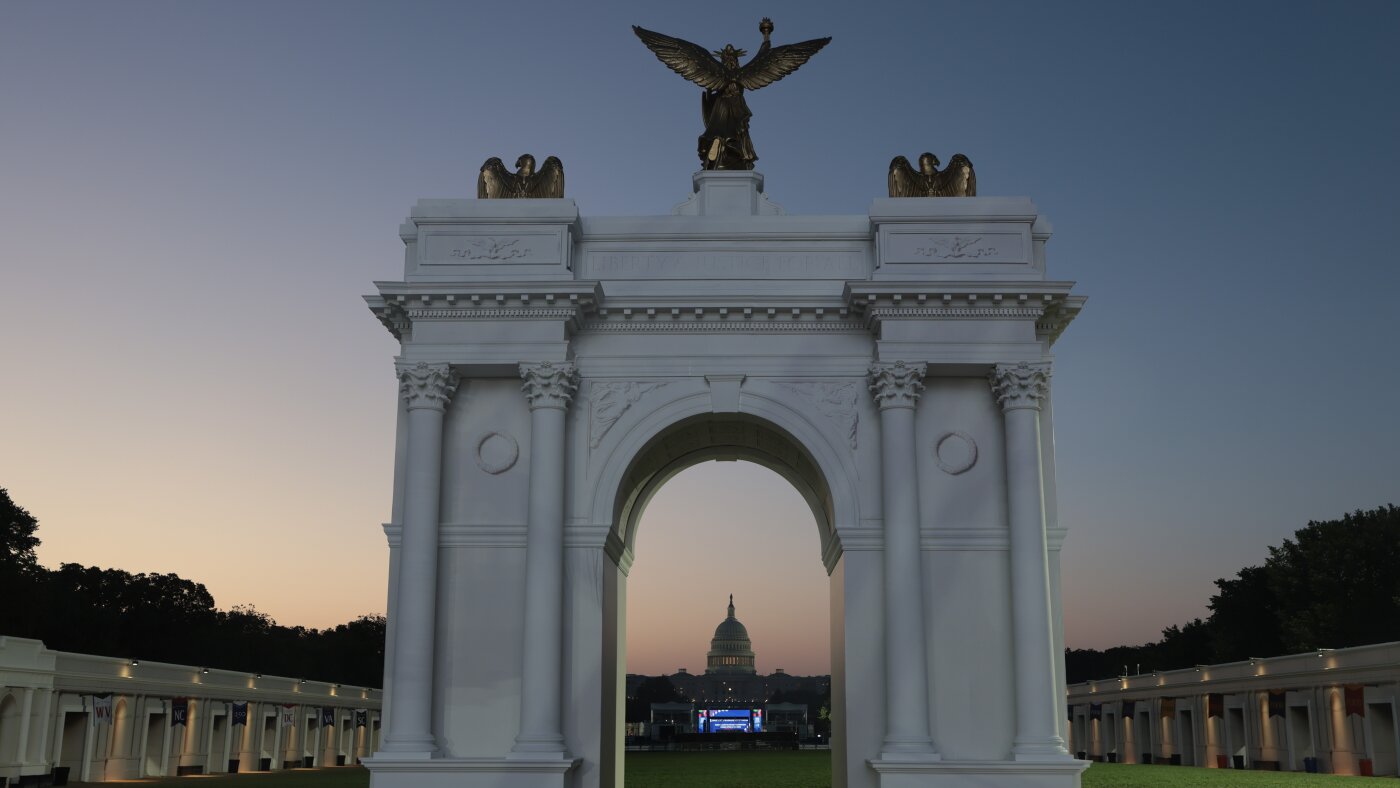
Controversial Arch Project Faces Legal and Public Hurdles
In a city known for its iconic skyline and strict building regulations, a new project proposed by the Trump administration is sparking significant debate. The plan to erect a 250-foot arch near the National Mall has led to discussions about the applicability of the Height of Buildings Act of 1910, a law that has long governed building heights in Washington, D.C.
The National Capital Planning Commission (NCPC) recently voted 8-1 to approve preliminary plans for the project. However, the commission will revisit the contentious height issue at their next meeting. Will Scharf, chair of the commission, highlighted the importance of this debate, stating, “I’m guessing that we’re going to have a vigorous debate on this subject when this project next comes before the commission.”
At the heart of the controversy is whether federal buildings are exempt from the Height Act. Scharf voiced his personal belief that the act does not apply to federal construction, a view seemingly supported by the Department of the Interior. A memo from the department’s Office of the Solicitor argued that the act is “just a local zoning ordinance and does not apply to the United States.”
The NCPC countered with its own memo, emphasizing that the act has historically been applied to federal projects. Meghan Hottel-Cox, the commission’s general counsel, warned that changing this interpretation “could fundamentally reshape the city’s architectural fabric.”
Protests have erupted against the arch, with opponents citing its potential to obstruct historic views between the Lincoln Memorial and Arlington National Cemetery. They also criticize the project’s lack of congressional authorization and the speed of its approval process. Kristopher Reichert, a local resident, expressed during a meeting, “No administration, regardless of party, should claim the privilege of reshaping America’s monumental core without first demonstrating the restraint that has defined our republic for nearly 250 years.”
Understanding D.C.’s Height Limits
While many assume D.C.’s height limits were established to protect views of the Washington Monument, they were actually implemented for practical reasons. Concerns about light, air, and fire safety led Congress to pass the first Height of Buildings Act in 1899, which was revised in 1910 to remove federal exemptions.
Elizabeth Morton, an urban design consultant, noted, “It’s really about the relationship of a building to the street and to the public realm around it.” Exceptions to the height limits have been rare, with some structures like the Old Post Office Tower and the Basilica of the National Shrine receiving individual exemptions.
Potential Impacts of the Arch Decision
The NCPC suggests a compromise that could allow the arch to comply with height restrictions. By lowering the arch’s height and increasing the height of the statues on top, the proposal could maintain the desired overall height without violating the act.
However, Sara Bronin, a law professor specializing in property and land use, is skeptical of the Interior Department’s argument for exempting federal buildings from the act. “The nature of the back-and-forth between the two federal agencies suggests that this may be a matter that will show up at some point in court,” she said.
The commission has requested more justification for the proposed height and consideration of alternative designs. Priya Jain, representing the Society of Architectural Historians, criticized the lack of effort to mitigate the project’s adverse effects, stating, “We believe this effort has been seriously lacking.”
As discussions continue, the outcome could have significant implications for future construction in the nation’s capital. Evan Cash, a commission member, emphasized the importance of the Height Act, saying, “It is an act of Congress legislating for the nation’s capital at a time when Congress directly controlled the district’s government in 1910.”
This article was originally written by www.npr.org