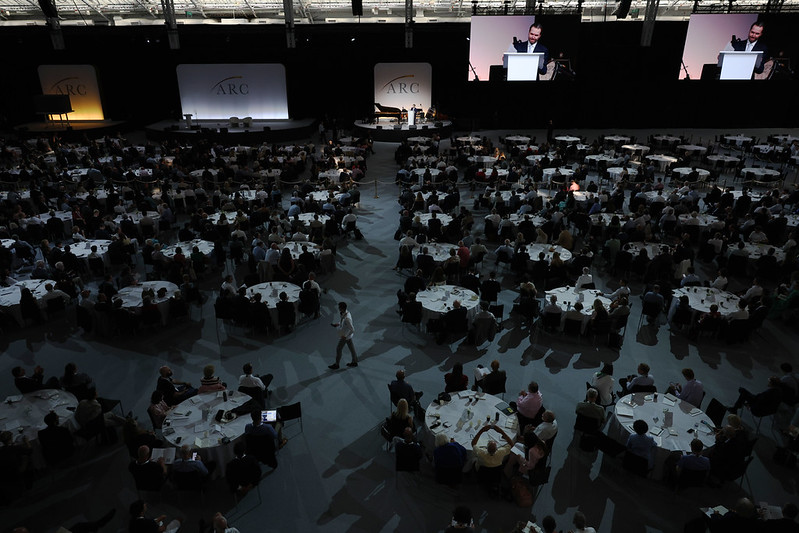
(Photo: Ryan Jenkinson/Parsons Media)
The second day of the Alliance for Responsible Citizenship (ARC) conference delved into a critical question: how can Western civilization be reconstructed? While the first day explored its deconstruction, the focus shifted to renewing the foundations that once supported it, particularly its Christian roots.
Speakers at the conference emphasized the need for a “mindset shift” across various sectors, including technology, energy, economy, family, education, and art. A recurring theme was the necessity of reviving Christian values as a cornerstone for rebuilding Western civilization.
Michael Shellenberger, a journalist and author, highlighted the issue: “The remarkable progress of science, technology and industry has weakened belief in the transcendent God and world order, without which people lack a way to make sense of inequality and suffering.” He pointed out that this has led to an “anti-civilization discourse” fueled by unmet spiritual and psychological needs.
Shellenberger noted that efforts to bolster faith in Christianity have largely fallen short. He observed, “While there are some signs of a recent uptick in religiosity, the long-term trajectory is away from it.” He criticized the rise of “utopian dream worlds” sold by anti-civilization activists, which misattribute harm to civilization itself.
He proposed combatting these narratives by highlighting the damages of anti-civilization policies and reinforcing the merits of Western civilization: “to make extremely clear the harms that anti-civilization policies cause, how they are linked together in a single de-civilising project, and why Western civilization remains the fairest and most humane form of social organisation ever created.”
Ross Douthat, a conservative Catholic thinker, warned of a potential “mass extinction” of shared customs and institutions due to increasing digitalization. He stressed the importance of maintaining faith in both religious and optimistic forms to ensure societal survival.
Melanie Phillips, a Jewish commentator, argued for the crucial role of education in preserving cultural values. She criticized contemporary education systems for promoting moral and cultural relativism, suggesting that real greatness stems from the “Hebrew Bible mediated by Christianity.”
Phillips asserted, “Judaism and Christianity provided not only the moral scaffolding of the West but enabled the West to become the powerhouse it became.” She advocated for reconstructing this foundational scaffolding to sustain Western civilization.
Ayaan Hirsi Ali called for challenging the “tyranny of feelings” prevalent in modern culture, advocating for a return to transcendent truths and a sense of God as the Creator. Nigel Farage emphasized restoring community and family values, reflecting on the cohesive communities of his past.
Rod Dreher, author of The Benedict Option, expressed concerns about AI and digital technology eroding human connections. He warned against preferring digital substitutes over real-life relationships, describing this trend as a “voice of the devil.”
Theologian Dr. Johannes Hartl emphasized the need for genuine spiritual awakening among the youth, cautioning against superficial religiosity. He highlighted the importance of prayer and encountering the living God, urging churches to focus on being houses of prayer.
Dreher echoed these sentiments, stressing that young people are searching for meaning, community, and purpose. He warned that if these needs are not met, they may turn to harmful ideologies, urging Christians to actively guide them toward truth and spiritual fulfillment.
This article was originally written by www.christiantoday.com