
(Photo: Andrew Parsons / Parsons Media)
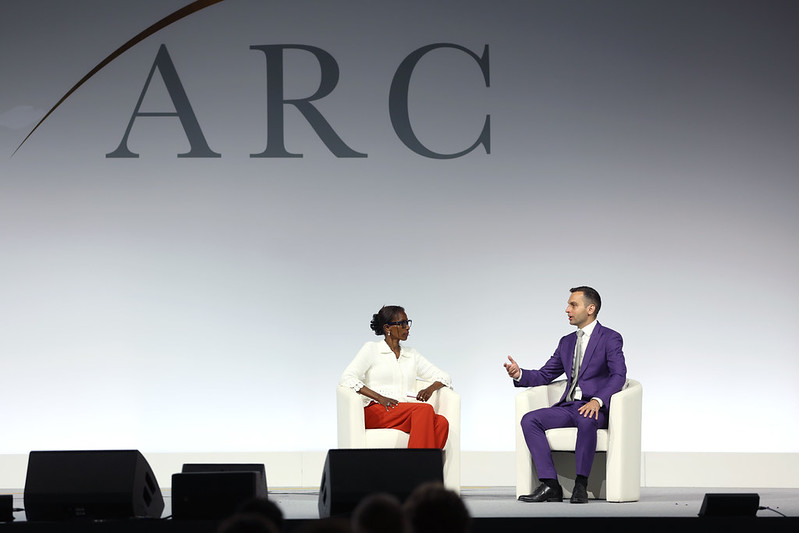
This week, London became a focal point for discussions on the perceived existential threats facing Western society. At the heart of these discussions was the Alliance for Responsible Citizenship (ARC) conference, attracting thousands of international delegates concerned about reversing what they see as a societal decline.
The conference drew a diverse group, many with Christian beliefs or sympathies, reflecting on the historical role of Christianity in shaping Western civilization and its potential to guide future progress. Notable Christian speakers included Ayaan Hirsi Ali, Carl Trueman, and Os Guinness, among others, with faith and spirituality mentioned frequently throughout the sessions.
Outside the venue, protests labeled the event as “fascist,” but inside, attendees focused on dissecting the “decades of deconstruction” that they believe have led to current societal challenges, while also exploring potential pathways for “reconstruction” to promote freedom and prosperity.
Ayaan Hirsi Ali, a prominent conservative voice with firsthand experience of Islam and Communism in Somalia, voiced concerns about Western nations adopting these ideologies. She described her past experiences under such systems as marked by “fear,” “propaganda,” and a lack of personal freedoms, urging the West to resist these influences and instead strengthen its foundational pillars like critical thinking and personal accountability.
Hirsi Ali challenged Western institutions to stand firm against Islamist demands, asking rhetorically, “If Sharia law is so fantastic, why are so many Muslims moving to the infidel West?” She critiqued the lure of utopian ideologies, warning they lead to familiar outcomes of debt and deprivation, as seen historically from the Soviet Union to contemporary examples.
She argued that the “Christian Western civilization” offers no alternative in its contributions to society and emphasized the importance of maintaining accountability structures, which she believes have been undermined by accusations of white supremacy.
Citing the scandal of grooming gangs in Britain, Hirsi Ali argued that a breakdown in institutional accountability has tarnished the West’s moral standing globally, making it difficult for Western leaders to advocate for human rights elsewhere.
Theologian Carl Trueman, author of Crisis of Confidence, suggested that the West is experiencing “chaotic times,” with much of the turmoil linked to a “psychologised,” “sexualised,” and “politicised” sense of self. He noted a modern aversion to marriage, attributing it to perceptions of oppression rather than the effects of no-fault divorce, which he argues has transformed marriage into a sentimental bond, often leaving children as “collateral damage.”
Trueman also addressed the pressures on freedom of speech, once a hallmark of democratic societies, now increasingly constrained by the notion that offending someone equates to an act of violence. He cautioned that threats to free speech often precede threats to freedom of religion, particularly Christianity, which traditionally enforced sexual norms.
GB News co-owner Sir Paul Marshall advocated for a resurgence of Western confidence to combat what he described as the “destruction” of civilization by ideologies such as critical race theory and extreme environmental policies. He criticized “radical progressivism” for taking ideas from classical liberalism but stripping them of their roots in faith and responsibility.
Marshall warned that progressives’ disregard for religion contributes to cultural relativism and a denial of historical achievements, risking the loss of societal moral direction. Without truth-telling, he argued, societies lose their guiding principles and ultimately, their soul.
Conservative leader Kemi Badenoch, identifying as a “cultural Christian,” underscored the importance of preserving key institutions like the Church, army, and monarchy for the enduring greatness of Britain, despite admitting her infrequent church attendance.
This article was originally written by www.christiantoday.com