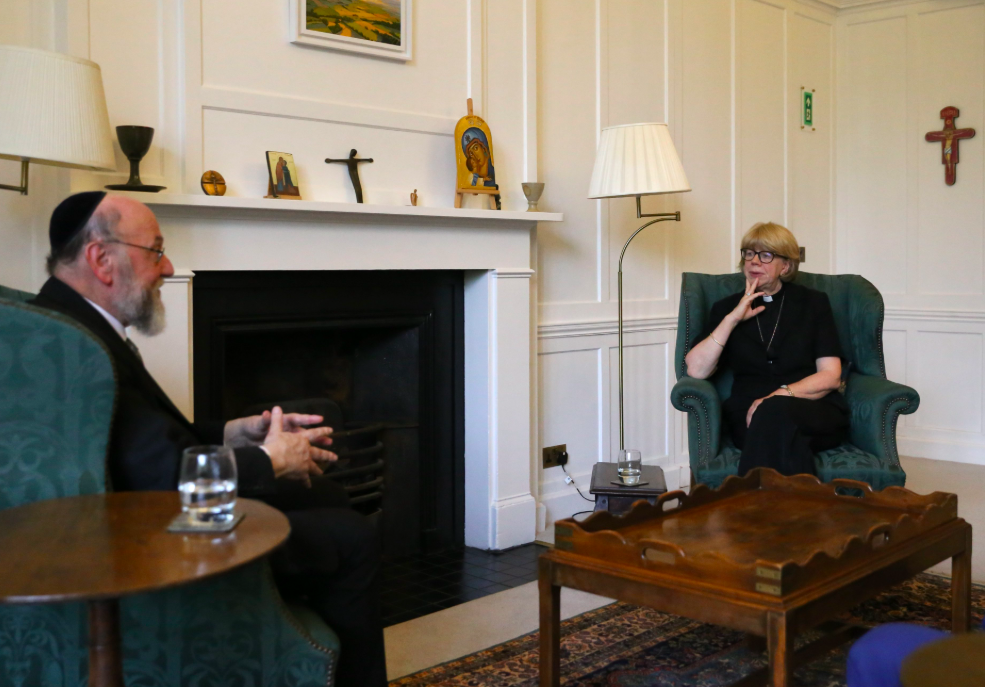
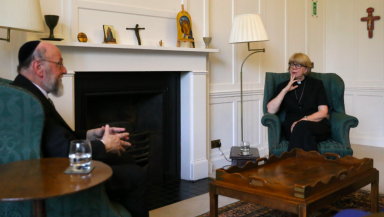
(Photo: Lambeth Palace)
In a bid to mend the strains in Christian-Jewish relations, the Archbishop of Canterbury, Sarah Mullally, convened a meeting with Chief Rabbi Sir Ephraim Mirvis at Lambeth Palace. This dialogue comes on the heels of the Church of England General Synod’s controversial decision to “hear” the Kairos II document.
After the meeting, Archbishop Mullally expressed gratitude for the “honest conversation” with the Chief Rabbi. She acknowledged the pain felt within the Jewish community following the Synod’s decision and affirmed the Church’s recognition of the deep connection between the Jewish people and the State of Israel.
Emphasizing the importance of peace and dignity, the Archbishop stated, “every person – Christian, Jewish, and Muslim; Palestinian and Israeli – deserves to live in safety, dignity, and peace.” She reaffirmed support for Palestinian Christians and British Jews, highlighting the widespread impact of Middle Eastern conflicts on individuals connected by faith, family, or heritage.
The Archbishop reiterated the Church of England’s commitment to valuing and protecting every faith within the national fabric, including the Jewish community. “I will always stand in solidarity with the Jewish community in this country,” she added, expressing hope for renewed dialogue and understanding amidst current tensions.
Chief Rabbi Mirvis, in his statement, detailed their “comprehensive discussion” on the Synod’s decision to engage with the Kairos Palestine II document. He described its content as having “alarming and appalling elements,” reflecting the deep pain it inflicted on the Jewish community. He emphasized the need for the Church to repair the damage done to Christian-Jewish relations.
The Synod, which met in York, opted to “hear” rather than “receive” the Kairos II document. Originating from the Palestinian Christian movement Kairos Palestine, the document criticizes Israel’s actions in Gaza, labeling them as genocide and portraying Israel as a colonial, apartheid state. Chief Rabbi Mirvis had previously urged rejection of the document, which he regarded as “political activism dressed up as theology” and accused it of containing falsehoods that challenge Israel’s existence.
In response to Jewish leaders’ objections, Archbishop Mullally clarified that hearing the document did not imply agreement with its contents. Meanwhile, a group of pastors, theologians, and lay leaders issued a “Declaration Against Kairos II,” denouncing it as “inaccurate, one-sided, and dangerous rhetoric” that baselessly accuses Israel of genocide.
Regan King, a London pastor involved in the declaration, criticized the Synod’s decision, suggesting it marked a departure from the Church’s historical support for Jewish people. He stressed the Church’s duty to speak truthfully and reject narratives undermining Israel’s legitimacy. Anglican theologian Ian Paul also questioned the exclusive attention given to Palestinian voices, arguing for a more balanced engagement that includes diverse perspectives.
Signatories of the declaration include Rev Hayley Ace, of Christian Action Against Antisemitism, and Dr Juergen Buehler, president of the International Christian Embassy Jerusalem.
This article was originally written by www.christiantoday.com