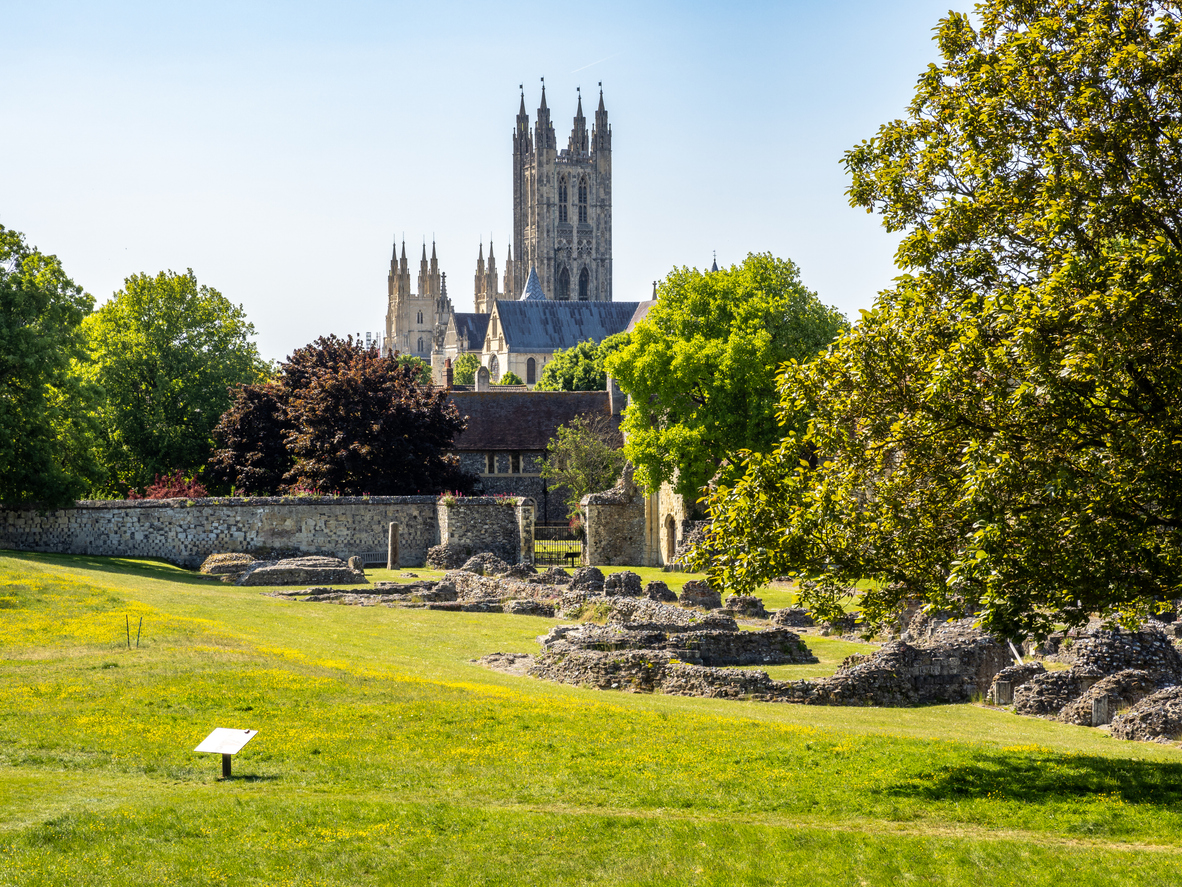
Amidst the ruins of history, the legacy of St Augustine stands tall. As the first Archbishop of Canterbury, his mission 1,400 years ago laid the cornerstone of the English Church and continues to influence the fabric of Christianity today.
Historical Background
During the late 6th century, Pope Gregory the Great aimed to expand Christianity’s reach beyond Roman territories. This vision led to missions across Europe, including England, where Anglo-Saxon paganism had taken hold after the Roman Empire’s collapse. You can read more about Pope Gregory’s efforts here.
The Journey to England
Before becoming Pope, Gregory encountered fair-skinned, fair-haired slaves in Rome, originating from Britain. Inspired by this encounter, he famously remarked, “Non Angli, sed angeli” (“Not Angles, but angels!”). Though he wished to travel to England himself, he eventually sent Augustine and forty monks as missionaries once he became Pope.
Augustine’s Mission
In AD 597, Augustine arrived in Kent, greeted by King Æthelbert and his Christian wife, Queen Bertha. With Bertha’s chapel at his disposal, Augustine preached to the locals, leading to King Æthelbert’s baptism on White Sunday and the conversion of 10,000 Kentish people by Christmas of the same year. The king provided land for a cathedral and monastery, which would become significant religious sites.
Establishing the Church
Augustine was consecrated as an archbishop in Arles and returned to Kent with more monks. He founded Christ Church and the Abbey of Saints Peter and Paul, solidifying Canterbury as the center for evangelical work in England. His efforts extended to ordaining bishops and creating dioceses in London and Rochester. Augustine’s influence ensured Canterbury Cathedral became the mother church of the English Church.
Pope Gregory advised Augustine to convert pagan sites for Christian worship, a practice validated by archaeological finds like the Roman temple beneath a church in Stoke Mandeville, discovered during HS2 excavations.
The Church of England’s Roots
Pope Gregory’s mission planted the seeds for the English Church, known as “Ecclesia Anglicana.” It evolved into the Church of England after separating from papal authority under Henry VIII, while the term “Anglican” reflects its English origins. The Anglican Communion now stands as one of the largest global Christian denominations.
Augustine died on 26 May 604 or 605 and was buried at his abbey, a site for early archbishops’ burials. The Venerable Bede’s writings in “Ecclesiastical History of the English People” are vital sources of Augustine’s story. Though never canonized, Augustine is remembered as the “Apostle to the English,” a title sometimes attributed to Pope Gregory.
Honoring St Augustine
Each 26 May, St Augustine’s contributions are commemorated in the Church calendar. His abbey in Canterbury became a pilgrimage site until the English Reformation led to the destruction of his shrine. Seventeen churches in England are dedicated to him, predominantly in the southeast.
In 1844, a cross was erected at his landing site in Thanet, known as St Augustine’s Cross. A plaque nearby recounts his arrival and initial sermon to the English. In 1988, Canterbury Cathedral, St Augustine’s Abbey, and St Martin’s Church were designated UNESCO World Heritage sites. A 19-mile walking trail, the Way of St Augustine, traces his journey from Ramsgate to Canterbury.
A Lasting Legacy
St Augustine’s role as the first Archbishop of Canterbury initiated an unbroken line of archbishops over 1,400 years, with the current archbishop being the 106th. The church he helped establish is now a cornerstone of the Anglican Communion, a global Christian network.
Collect Prayer
The Anglican collect prayer for St Augustine is:
“Almighty God, whose servant Augustine was sent as the apostle of the English people: grant that, as he laboured in the Spirit to preach Christ’s gospel in this land, so all who hear the good news may strive to make your truth known in all the world; through Jesus Christ your Son our Lord, who is alive and reigns with you, in the unity of the Holy Spirit, one God, now and for ever. Amen.”
This article was originally written by www.christiantoday.com