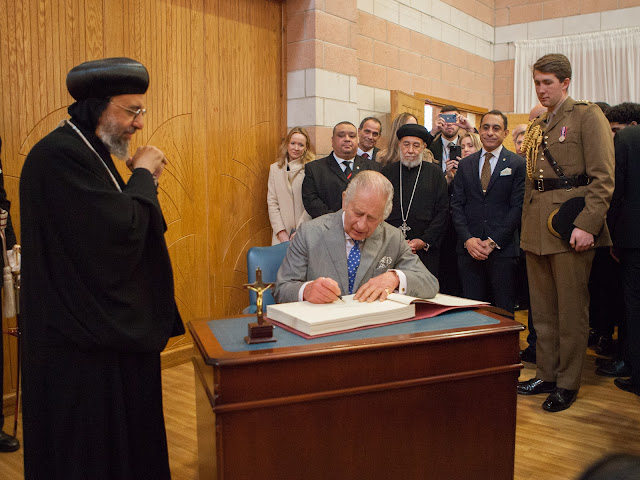
(Photo: The Coptic Orthodox Church Centre UK)
The role of the British monarch is undergoing a transformation in its emphasis, highlighting a broader approach to faith representation in a multi-faith society. Recent discourse has suggested a shift from the traditional title of Supreme Governor of the Church of England and Defender of the Faith, towards fostering “the space for faith within the multi-faith nation.”
King Charles’ efforts to promote religious freedom and mutual respect are seen as commendable steps towards peaceful coexistence. In today’s diverse world, these goals resonate with many, especially Christians who advocate for the right of every individual to follow their beliefs without fear.
However, a key distinction must be acknowledged. While the State’s role is to safeguard religious freedom, the Church’s mission is to deliver the gospel’s truth.
The king may indeed champion the freedom of all faiths. Yet, the Church maintains that not all faiths convey the same truth, as underscored by Jesus’ pronouncement, “I am the way, the truth, and the life. No one comes to the Father except through me.” Christianity is portrayed not merely as another path but as the revelation of God’s intervention through His Son.
The Church’s purpose extends beyond assuring religious expression; it is to herald the message of salvation through Jesus Christ.
History reminds us that earthly monarchies are temporary, whereas the Christian faith celebrates a King whose reign is eternal. Earthly crowns are inherited; the divine crown was borne out of sacrifice. Earthly kingdoms may falter; the Kingdom of God remains steadfast.
Traditionally, the British Crown acknowledges this through the Coronation ceremony, where the monarch is anointed under God’s authority. The sovereign’s reign is considered by divine permission, with accountability to higher divine authority.
In accordance with scripture, Christians respect and pray for the king, striving for the nation’s prosperity under his reign. Yet, their ultimate loyalty is reserved for Christ alone.
The Church thrives when it serves the King who first wore a crown of thorns, signifying humility before glory.
Thus, while supporting religious freedom for all, the Church remains committed to its paramount mission: to reveal the One whose name surpasses all others.
Ultimately, when all earthly powers have faded, there remains one eternal King, Jesus.
Canon J.John is the Director of Philo Trust. Visit his website at www.canonjjohn.com or follow him on Facebook, Instagram or Twitter.
This article was originally written by www.christiantoday.com